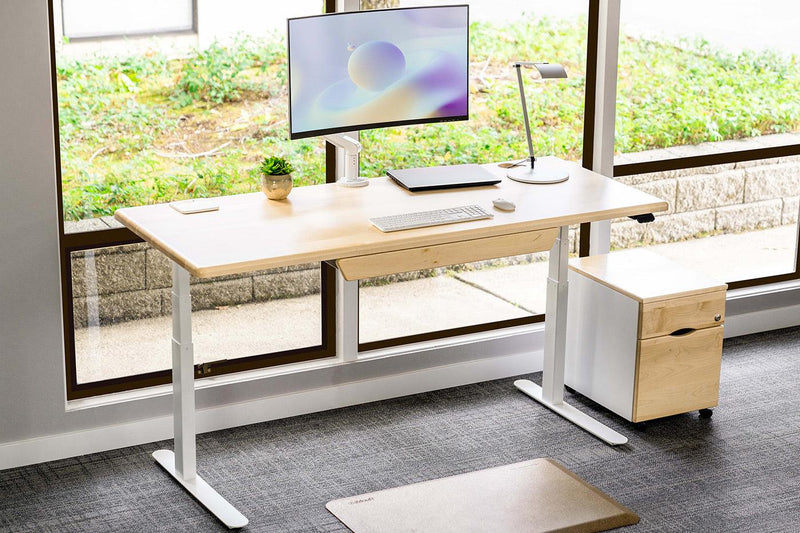
Private offices reduce distractions and boost focus, productivity, and deep work.
That is a strong claim, but the open office vs private office debate is rarely that clean in practice.
In this article, you will know exactly which layout fits your work type, where each one fails, and how the right furniture choices, including your desk, shape both environments in ways most guides completely ignore.
What Research Says About Noise and Focus Loss
Noise is the single biggest performance variable that separates open offices from private ones. It is not just annoying. It physically changes how your brain processes information.
A study published in PMC (National Institutes of Health) found that exposure to 95 dBA of noise significantly reduces mental workload and impairs both visual and auditory attention.
For context, a busy open office commonly reaches 65 to 70 dBA. That is well below 95, but sustained exposure at that level still pulls focus away from complex tasks over time.
Background noise can easily disrupt attention and shift focus away from the task, according to Loop Earplugs. But here is the part most open office conversations skip: it does not just slow you down temporarily. It costs you the work you were already doing.
What Noise Does to Your Brain Chemistry
High levels of background noise are linked to increased stress and reduced cognitive performance. That stress is not just psychological. It is biochemical.
According to Scientific American, stress caused by noise may lower dopamine levels in the prefrontal cortex, which weakens the brain's control over information processing. L
ower dopamine in that region means slower decision-making, reduced working memory, and a harder time filtering out irrelevant stimuli.
So the problem compounds. Noise causes stress. Stress reduces dopamine. Lower dopamine makes noise harder to ignore. Open plan office noise is not just an inconvenience. It is a loop.
Long-Term Cognitive Risk
The Alzheimer's Drug Discovery Foundation reports that higher residential noise levels are strongly linked to a greater risk of mild cognitive impairment, increasing by 36% per 10 dB(A).
That is not a workplace study, but it speaks to cumulative exposure effects that apply in any noisy environment over time.
And road traffic noise exposure has been linked to a 4% higher risk of depression, according to research by Dzhambov and Lercher published in Nature.
For people in open offices near busy streets or in high-traffic urban buildings, this is not a remote possibility.
The data is not subtle. Sustained noise degrades cognitive performance, elevates stress hormones, and over time poses real mental health risks.
That is the full case against open plan office noise, and it is rarely made this completely.
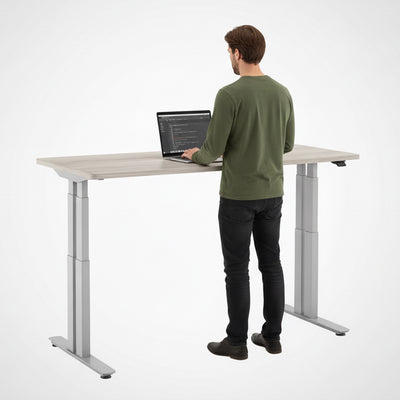
Open Offices Were Sold as Collaboration Tools. Not Everyone Agrees.
The open office was designed to increase spontaneous collaboration, reduce hierarchy, and cut real estate costs. Two of those three goals are genuinely served. The third, collaboration, is more complicated.
When working with clients in commercial office settings, we have seen the same pattern repeatedly.
Open layouts increase surface-level interaction: quick questions, side comments, short check-ins.
But they consistently suppress deep collaboration, the kind that produces actual creative output, because focused thinking becomes nearly impossible alongside it.
Shared office productivity does get a boost for specific roles. Sales teams, customer support, and project coordinators who need constant quick communication benefit from the open layout.
The energy is real, and the spontaneous information-sharing does happen. But for roles that require sustained concentration, writing, analysis, coding, design, the open plan office is a daily tax on cognitive output.
When Open Offices Genuinely Help
Open offices work best when the work itself is conversational. Teams that sync frequently, need fast feedback loops, or thrive on collective energy get real value from the shared space.
Startups in early-stage sprints, creative agencies in brainstorming mode, and sales floors running live campaigns all benefit from this environment.
The layout also reduces the social friction that comes from physical hierarchy.
When everyone sits together, including leadership, communication tends to be faster and less filtered. That is a genuine structural advantage for flat-organization companies.
-
High-frequency team communication
-
Fast-feedback creative brainstorming
-
Sales and customer-facing roles
-
Flat organizational structures
-
Early-stage teams building shared culture
Where Private Setups Outperform Open Layouts
Private office benefits are strongest for cognitively demanding, output-focused roles. The mechanism is simple: fewer interruptions mean fewer cognitive resets, and fewer cognitive resets mean more completed deep work per hour.
A writer finishing a long-form piece, a financial analyst building a model, a product manager writing a strategy document.
All of these benefit directly from the controlled acoustic environment a private office provides. The work does not just feel easier in a private space. It is measurably faster and more accurate.
The Cognitive Load Difference
In an open office, your brain is constantly doing background processing. Monitoring conversations for your name, filtering irrelevant sounds, suppressing responses to stimuli.
This is called selective attention, and it consumes real cognitive resources even when you think you are focused.
A private office eliminates most of that background load. Your working memory gets more capacity to dedicate to the actual task.
That is why people in private offices often report finishing the same work in less time. It is not discipline or preference. It is available mental bandwidth.
Focus in Open Offices vs Private Offices: A Direct Comparison
The honest answer is that focus in open offices is fundamentally reactive, meaning you work around interruptions.
Focus in private offices is proactive, meaning you structure your time by your own rhythm. Both can produce good work. But only one of them scales reliably across a full workday of complex tasks.
-
Deep writing, coding, or analysis: private office wins
-
High-volume communication roles: open office wins
-
Video or audio production: private office wins
-
Team coordination and project management: open office competitive
-
Strategy, research, and planning: private office wins
How Furniture Choices Affect Both Environments
The open office vs private office debate almost always ignores furniture. That is a mistake. The physical setup inside each environment determines whether the theoretical benefits actually show up in practice.
In an open office, a standing desk is one of the most practical tools for reclaiming personal focus.
Standing naturally reduces the casual social interaction that comes from sitting at eye level with colleagues. It also changes how you carry yourself, and that posture shift affects how others approach you.
Open plan workers with standing desks report fewer interruptions without any social awkwardness, because the body language signals active work.
The Standing Desk Advantage in Open Plans
Height-adjustable desks from iMovR give open-office workers a physical tool for focus signaling. When you raise the desk to standing height, you are communicating without words that you are in work mode.
That subtle shift reduces drop-by interruptions and gives you back blocks of uninterrupted time without requiring a private room.
The ergonomic benefit matters too. Office layout productivity goes up when physical discomfort goes down.
Workers in open offices who sit on low-quality chairs at fixed-height desks tend to move more, shift more, and distract their neighbors more.
A properly fitted ergonomic setup keeps people settled and focused, which benefits everyone in the shared space.
Furniture in Private Offices
Private offices give people full control over their environment, and that control is frequently misused. The most common mistake is treating the private office as a storage room with a desk.
Cluttered surfaces, poor monitor positioning, and chairs set at the wrong height all reduce the cognitive benefits the private space is supposed to deliver.
In our experience working with remote professionals and solo practitioners, the people who get the most out of private offices are the ones who treat the setup as deliberately as they would a shared space.
That means a standing desk configured for correct ergonomic height, a monitor at eye level, and a clean surface that signals to the brain that this is a work zone.
The private office without intentional setup is just a quieter version of the open office. The noise is gone but the cognitive drag from poor posture and cluttered sight lines remains.
Standing Meeting Tables as a Middle-Ground Solution
The either-or framing of open office vs private office misses a hybrid option that more companies are using effectively: designated standing collaboration zones within otherwise private or semi-private layouts.
Standing meeting tables change the character of collaboration. Meetings become shorter and more focused because standing creates a mild physical urgency that seated meetings do not have.
Why Standing Zones Work in Both Environments
For open offices, a standing collaboration table gives teams a defined space for the intentional conversations that the open plan was supposed to produce. Instead of constant ambient interaction disrupting everyone, deliberate collaboration happens at a designated zone, and the rest of the office floor becomes quieter as a result.
For private office setups, a standing table in a shared meeting room gives people a reason to leave their individual spaces for collaboration, then return.
That rhythm, focused solo work followed by brief structured collaboration, is actually closer to how creative and knowledge work gets done well.
Building Movement Into the Workday Through Layout
One underrated benefit of standing zones is the movement they naturally introduce. Office layout productivity is not just about reducing distractions.
It is also about managing physical energy through the day. Sitting for eight hours, even in a quiet private office, still produces the fatigue and attention dip that prolonged stillness causes.
A sit-stand routine, whether in an open plan or a private office, addresses this directly. Workers who alternate between sitting and standing report better energy and focus through the afternoon hours.
That 2024 study (Wiley Online Library) found that switching between positions improves both brain performance and physical health. The desk type matters as much as the office type.
Layout Matters Less Than Intentional Design
The open office vs private office question gets answered differently depending on who you ask, and that is because both environments can work and both can fail. The variable is not the layout. It is the intentionality behind it.
An open office with acoustic panels, dedicated focus zones, and height-adjustable desks produces better results than an open office with none of those things.
A private office with a poorly fitted chair, a cluttered desk, and a monitor at the wrong height does not deliver the productivity benefits the private space promises.
The physical environment inside the layout is what determines actual output.
That is the part of this debate that most comparisons skip. They treat open versus private as a fixed variable and draw conclusions from the category label. The real question is: what is the setup doing for the person in it?
The Checklist That Actually Matters
-
Does the environment minimize unintentional interruptions?
-
Is the desk height calibrated for ergonomic correctness?
-
Does the worker have control over their sit-stand ratio throughout the day?
-
Is there a designated collaboration space separate from deep work zones?
-
Does the setup support movement, not just sitting?
Whether the answers to those questions come from an open plan or a private room is secondary. The answers themselves are what drive performance.
If you are evaluating your current setup, start with the desk. A height-adjustable standing desk from iMovR gives you posture control, focus signaling, and movement in a single piece of furniture, regardless of whether your office is open or private.
The Setup Wins. Not the Label.
The open office vs private office debate produces more heat than light because it focuses on the container rather than what is inside it.
The workers who do their best work are not necessarily in the quietest rooms. They are in setups designed around how they actually think and move.
That means matching the workspace to the task type, controlling the acoustic environment as much as possible, and using the desk itself as a productivity tool rather than just a surface.
If your current setup, open plan or private, is not giving you consistent deep work, the desk is usually the first thing worth changing.
Explore the full range of iMovR standing and treadmill desks built for people who take their workspace as seriously as their work.