Freelancing now covers 41% of the U.S. workforce, up 13% since 2013.
That shift sounds like freedom on paper, but in reality it has quietly created a new kind of problem. Most freelancers are not working in offices anymore.
They are working from kitchen tables, couches, and makeshift corners that were never designed for long hours of focused work.
And that is where things start breaking down. A standing desk for freelancers is not just a modern workspace trend. It has become a practical response to how work has changed.
When your office is your home, your body starts paying the price for every poor setup decision you ignore.
This is where understanding your home office standing desk options becomes essential, not optional.
Why Freelancers End Up With the Worst Setups
Most freelancers do not intentionally design their workspace. They improvise it. At first, your kitchen table turns into your desk, the dining chair becomes your office seat, and your laptop basically is your whole workstation.
And honestly, it feels totally fine in the beginning. When you're just starting out freelancing, you're usually focused on getting the work done fast, not on building some perfect long-term setup.
But over time, this kind of environment creates hidden problems. A standing desk for freelancers becomes relevant here because it introduces structure into an unstructured space. Without structure, posture suffers first, followed by focus, and eventually productivity.
A home office standing desk solves a deeper issue than just height adjustment. It separates work from living space, even inside the same room.
That separation matters because your brain starts associating a specific posture and position with focused work. Without it, everything blends together, and your body pays the cost.
Even something as simple as a best desk for home office setup changes how seriously your work environment functions.
Standing desk for writers and journalists is not about luxury. It is about preventing long-term strain that builds silently over months of repetitive use.
What 6–8 Hours of Sitting at a Kitchen Table Does to Your Body
Extended sitting in an unsupported environment does not create immediate pain. It builds it slowly. This is why many freelancers ignore the issue until it becomes disruptive.
A standing desk for freelancers plays a corrective role here by breaking that long static cycle.
Posture collapse and spinal strain over time
When you're working at a kitchen table, you naturally end up leaning forward toward the screen. Over time, that messes with your spinal alignment and starts putting a lot of strain on your neck and lower back.
A proper standing desk in your home office fixes that pretty nicely, it brings the screen right up to eye level, so you’re not craning your head forward anymore.
Your weight gets distributed more evenly through your spine instead of everything dumping onto your neck and back.
A remote worker posture issue does not happen in a single day. It develops through repetition. Once your body adjusts to poor positioning, it starts to feel normal even when it is damaging.
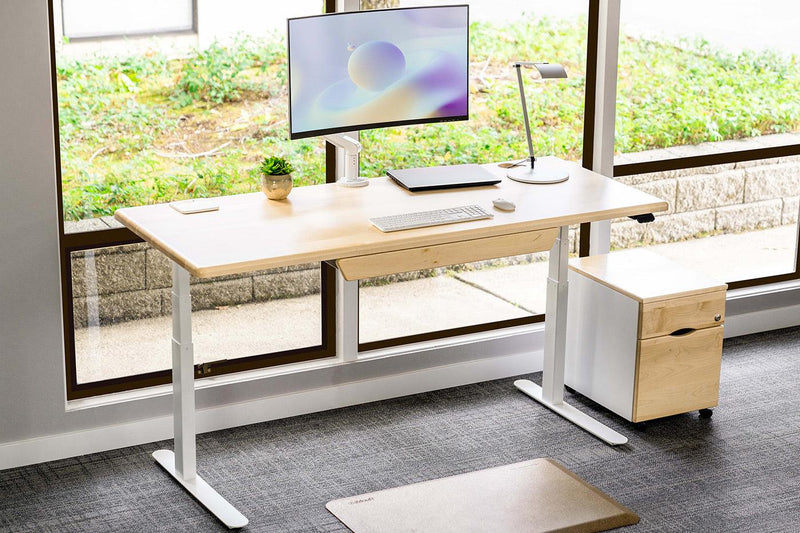
The P1 Elite Series — Built for Serious Workspaces
From minimalist setups to fully loaded workstations, the P1 Elite Series combines ultra-fast lift performance, exceptional stability, and premium desktop options designed for years of daily use.
Reduced circulation and mid-day energy crashes
You know how sitting all day kills your circulation? It straight-up drains your energy and makes it harder to stay focused.
Tons of freelancers feel that random afternoon crash without connecting it to being glued to their chair in a bad position.
Switching to a standing desk helps a ton because you’re constantly making little adjustments, shifting your weight, changing stance, which keeps your blood moving and your brain switched on for those marathon work sessions.
This is not about standing all day. It is about alternating positions so the body does not stay locked in one static state.
Why discomfort builds silently, not instantly
One of the biggest misconceptions about workspace strain is that it should feel immediate. In reality, discomfort accumulates gradually.
You might not notice anything in the first few weeks, but over time stiffness becomes your baseline. A best desk for home office setup prevents that slow accumulation by supporting proper alignment from the start.
A standing desk for freelancers is effective because it prevents adaptation to bad posture, rather than trying to fix it after damage is already done.
Why Freelancers Ignore Ergonomics Until Pain Forces Them To Care
Freelancers tend to prioritize output over environment. The focus is usually on deadlines, clients, and income.
Workspace design feels secondary until physical discomfort interrupts work itself. That is when people start searching for a standing desk for freelancers, usually after the problem has already escalated.
The “I’ll fix it later” productivity mindset
Many freelancers treat ergonomics as something to handle once things are “stable.” The reality is that stability never comes on its own.
A home office standing desk should be part of the initial setup, not a later upgrade. Waiting only allows poor posture habits to become deeply embedded.
Why comfort feels like a luxury, not a necessity
Comfort is often misunderstood as optional rather than functional. But a best desk for home office directly affects focus, endurance, and output quality.
When your body is uncomfortable, your attention shifts away from work without you realizing it.
A standing desk for freelancers is not about making work easier. It is about making it sustainable.
The hidden cost of delaying ergonomic upgrades
Delayed ergonomic decisions often lead to long-term issues such as chronic back tension, reduced focus, and lower productivity.
These costs are not immediate but compound over time. A home office standing desk reduces these risks by improving daily working conditions before damage accumulates.
The Small Space Problem, And Why It’s Not Really a Problem
Freelancers often believe they need large dedicated rooms to build proper work setups. That assumption is incorrect.
The real limitation is not space, but how space is used. A standing desk for freelancers is designed to work in compact environments, not just dedicated offices.
Why most freelancers misjudge their usable space
Corners, unused walls, and small gaps are often overlooked. A home office standing desk is designed specifically for these environments, allowing functional setups in tight spaces without compromising posture.
Compact standing desks that actually fit real homes
Modern designs focus on adaptability rather than size. A standing desk for freelancers can fit into bedrooms, shared apartments, or kitchen corners while still maintaining ergonomic alignment.
Even a standing desk small space setup can outperform traditional furniture when used correctly because it prioritizes body positioning over footprint.
Multi-purpose rooms and hybrid setups that work
Most freelancers work in shared environments rather than dedicated offices. A best desk for home office allows these spaces to serve multiple functions without sacrificing work quality.
A standing desk for freelancers turns flexible spaces into structured work zones without requiring permanent changes.

“I Only Work a Few Hours”
This is one of the most common justifications for ignoring ergonomics. The assumption is that short work sessions do not require proper setups. That assumption is misleading.
A standing desk for freelancers matters even more in short sessions because repetition matters more than duration.
Why short hours still create long-term strain
Even a few hours per day, repeated over months, can create significant posture issues. A home office standing desk reduces cumulative strain by introducing movement into each session.
The repetition problem vs total time problem
It is not the total number of hours that matters most. It is the repeated exposure to poor positioning. A remote worker posture issue develops through repetition, not intensity.
How posture consistency affects long-term health
Your body adapts to consistency. If your default position is poor, that becomes your long-term baseline. A standing desk for freelancers helps reset that baseline into a healthier alignment.
What Freelancers Should Actually Prioritize in a Desk Setup
A functional workspace is not about appearance. It is about consistency and alignment. A standing desk for freelancers should be evaluated on usability, not aesthetics.
Adjustability is the first requirement because the ability to switch between sitting and standing directly affects long-term comfort.
A home office standing desk that supports both positions allows flexibility throughout the workday.
Stability is equally important because movement during work disrupts focus. A best desk for home office must remain solid under continuous use.
Proper alignment completes the system. Screen height, elbow position, and wrist alignment all influence strain levels. A standing desk for freelancers helps maintain this structure consistently.
Why Active Workstations Are Replacing Traditional Desks
Work environments are shifting toward movement-based systems. Static seating is being replaced by adjustable setups that encourage posture variation. A standing desk for freelancers is part of this shift.
Movement improves focus because it prevents physical stagnation. A home office standing desk introduces natural variation into long working sessions.
Alternating posture also improves cognitive endurance. A remote worker posture improves when the body is not locked into a single position for extended periods.
This shift is not temporary. It reflects a broader move toward healthier work environments where flexibility and physical well-being are prioritized equally.
iMovR: Built for Freelancers Who Work Like Professionals
A standing desk for freelancers from iMovR is designed specifically for real-world home environments rather than traditional office layouts. It supports hybrid work styles where space is limited but productivity expectations remain high.
A home office standing desk in this category focuses on stability, adjustability, and long-term durability. These factors matter more than design aesthetics because freelancers rely on their workspace daily.
A best desk for home office is not a visual upgrade. It is a functional investment that supports posture, focus, and long-term work capacity without breakdown under consistent use.
How to Fix Your Setup in the Next 48 Hours
You do not need a full renovation to improve your workspace. Small adjustments can significantly reduce strain. A standing desk for freelancers helps long-term, but immediate changes start with posture alignment.
Screen height should be adjusted to eye level to reduce neck strain. Chair height should support elbows at a natural angle. A home office standing desk reinforces these positions over time.
Movement should be introduced into work sessions through regular breaks. Even minor shifts in position help reduce stiffness. A remote worker posture improves when static behavior is interrupted consistently.
Finally, identify which upgrade matters most. For most freelancers, the best desk for home office becomes the foundation for everything else.
Final Thought
Your workspace shapes your body more than you realize. Every hour spent at a poorly designed setup becomes part of a long-term pattern your body learns to accept.
A standing desk for freelancers is not about upgrading furniture. It is about breaking that pattern before it becomes permanent.
And the real question is not whether you need a better desk. It is how long you can afford to ignore the one you already have.
Explore professional-grade options at iMovR and upgrade your standing desk for freelancers setup for long-term performance.