80% of people using computers 4+ hours suffer back pain. Are you one of them?
Programmers sit longer and type more than almost anyone else, and the body absolutely keeps score.
An ergonomic desk setup for programmers is what keeps you coding at full capacity for years without your back, neck, or wrists staging a rebellion.
Why Programmers Specifically Suffer From Desk-Related Strain
Here is the thing about programmers: most people take breaks. Programmers hit a flow state and surface three hours later wondering why their neck hurts.
That is exactly how a slightly uncomfortable position becomes a long-term injury. It is not just sitting. It is sitting wrong, for too long, without even noticing.
RSI (Repetitive Strain Injury) is one of the most common issues developers deal with. Every keystroke puts tiny stress on the tendons in your wrists and forearms. Do that thousands of times a day and that stress quietly builds into real, persistent pain.
Neck strain works the same way. Leaning toward your screen while debugging puts up to 60 pounds of force on your neck, even though your head only weighs around 10 to 12 pounds in a neutral position. That math gets ugly fast.
84% of adults will experience back pain at some point, and right now 7.5% of the world is actively dealing with low back pain.
Programmers are well represented in those numbers. A good ergonomic desk setup for programmers tackles these problems early, before they become something a doctor needs to deal with.
Desk Height: How to Set It Correctly for Typing vs Standing
Desk height sounds simple, but it is the most commonly ignored variable in the whole setup. Most desks are built for someone around 5 feet 10 inches. If you are not that person, the default is already working against your posture for coders.
For seated typing, your elbows should sit at a 90-degree angle with your forearms flat and your wrists straight. Too high and your shoulders creep upward and tighten throughout the day. Too low and your wrists bend upward, which is a direct path to wrist strain for anyone typing all day.
The same 90-degree rule applies when you stand. Your keyboard should sit at a height where your arms hang naturally, no reaching up, no hunching forward.
A sit stand desk with motorized adjustment just handles all of this for you. Set your seated and standing heights once, save them as presets, and switch in seconds. Get this part wrong and honestly nothing else you adjust will fully make up for it.
Monitor Height and Distance: Single vs Dual Monitor Positioning
Your monitor is where your eyes live during a coding session, so getting it right is a big deal. The top of your screen should sit at or just below eye level. That one change alone stops your neck from tilting forward and down for hours at a stretch.
Distance matters just as much in a solid ergonomic desk setup for programmers. Sit back naturally, extend your arm, and your fingertips should just graze the screen. Any closer and your head starts creeping forward without you even realizing it.
If you run dual monitors, center them so the gap between the screens sits directly in front of you and angle each one slightly inward. If one screen is clearly your main, put it front and center and angle the second one to the side.
Never leave the secondary monitor flat to the side. That forces a full neck rotation all day long and it adds up fast.
A monitor arm is the cleanest fix here. It gives you precise control over height, tilt, and depth that no fixed stand can match, and it clears up desk space at the same time.
Keyboard Tray: When You Need One and When You Do Not
A standing desk with keyboard tray is a genuinely useful addition to an ergonomic desk setup for programmers, but it is not for everyone. It really comes down to one thing: your height relative to your desk.
Taller programmers benefit the most. When the desk is set to the right standing height for a tall frame, the typing surface can still be too high for comfortable seated work.
A keyboard tray drops the input surface below the desk level so your elbows stay at 90 degrees without forcing the whole desk awkwardly low.
Trackless Keyboard Tray
$245
Fix your typing posture instantly. This trackless design gives you more stability, more legroom, and less wrist strain—without the bulky rails most trays require.
Tilt
+10° to -15°
Design
Trackless mount
Stability
No wobble typing
Storage
360° stow-away
For shorter users, the desk surface usually already lands at the right height for typing. Adding a tray in that case can actually create new alignment problems instead of solving existing ones.
A standing desk with keyboard tray is also great in shared setups. When two developers of different heights share the same desk, a tray lets each person dial in their own typing height independently. That kind of flexibility is tough to replicate any other way.
Mouse Placement and Wrist Alignment
Your mouse sits beside your keyboard, which already puts it in a slightly awkward spot. Most people reach a little outward and upward to use it, and that small reach happens hundreds of times every hour. Over weeks and months, that quietly becomes a real source of wrist strain and shoulder fatigue.
The fix is straightforward: get the mouse as close to the keyboard as possible. A full-size keyboard with a number pad pushes the mouse way further out than most developers actually need it.
A tenkeyless keyboard removes that number pad and brings the mouse significantly closer to your body.
That single swap reduces lateral arm extension and takes real pressure off your shoulder and wrist on the mouse side.
Throughout all of this, your wrist should stay neutral. No bending up, no bending down, no twisting.
In a well-built ergonomic desk setup for programmers, the keyboard and mouse work together as one clean input zone, not two separate items dropped wherever they happen to fit.
Chair vs Standing Ratio: How Long to Sit vs Stand During a Coding Session
Let's get one thing straight: standing all day is not the goal. Movement is the goal. The real value of a standing desk for long hours is the switching, not the standing itself.
A solid starting point is one hour of standing for every one to two hours of sitting. But honestly, the simpler rule is this: move often, and make it easy enough that you actually do it consistently.
If you are new to standing desks, ease into it. Start with 20 to 30 minutes of standing per hour and build from there over a few weeks.
Going too hard too soon leads to sore feet and an achy lower back, which is exactly why most people abandon height-adjustable setups.
A standing desk for programmers with saved height presets removes every excuse from the equation. You press a button and the desk moves in under 10 seconds. If switching positions requires effort, it simply will not happen.
Cable Management for a Clean Dev Setup
A developer's desk collects cables at an impressive rate: power, monitors, USB hubs, keyboard, mouse, headphones, webcam, microphone. Leave them alone and within a week it looks like the desk ate a bowl of spaghetti. Cable management in an ergonomic desk setup for programmers is a functional need, not just something you do for aesthetics.
A height-adjustable desk moves up and down all day. If your cables are not set up to handle that movement, they will pull tight or bunch up on the floor every time you switch positions.
Run a cable spine or flexible cable chain down the desk leg to give your cables a guided path that moves with the desk. Velcro ties at the top keep things tidy without anything being permanently locked in place.

Mount a cable tray under the desk surface for your power strip and extra cable length, and get all of it off the desktop entirely.
When every cable has a dedicated route, swapping or adding a device takes 30 seconds instead of 30 minutes.
Recommended Accessories for an Ergonomic Programmer Setup
The desk handles the heavy lifting, but a few accessories close the gaps it cannot on its own. Each of these solves a specific problem in an ergonomic desk setup for programmers.
-
Monitor arm: Precise height, tilt, and depth control. Essential for dual monitors and anyone whose fixed stand leaves the screen at the wrong position
-
Standing desk with keyboard tray: Drops the typing surface below desk level, perfect for taller users who need that extra adjustment
-
Footrest: Keeps your feet flat and hips properly angled, especially if your feet do not comfortably reach the floor at the right chair height
-
Anti-fatigue mat: Reduces pressure on feet, knees, and lower back during standing. Non-negotiable for anyone using a standing desk for long hours regularly
None of these are optional extras. Each one is part of getting the ergonomic desk setup for programmers properly finished.
Product Recommendations: P1 ELITE, Monitor Arms, and Keyboard Tray
iMovR P1 ELITE Standing Desk
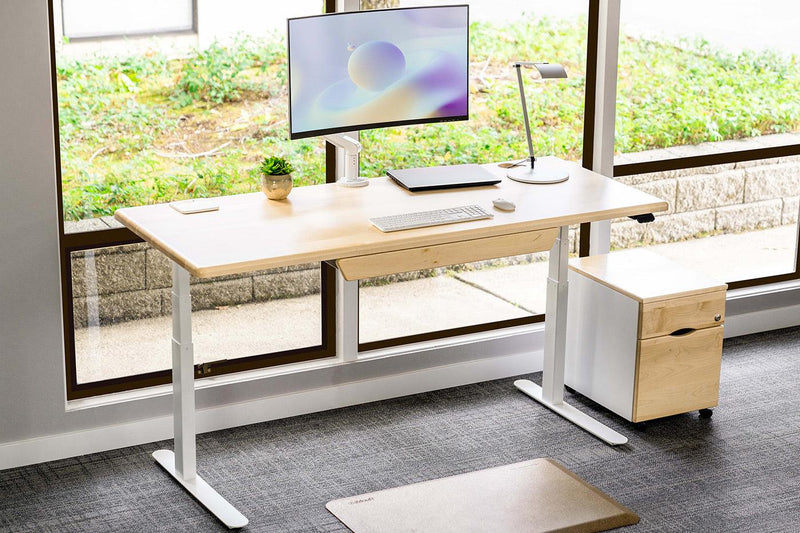
The iMovR P1 ELITE is built for people who need a dependable standing desk for long hours. It covers a wide height range, moves smoothly with motorized adjustment, and lets you save presets so switching positions never interrupts your work.
The surface is large enough for dual monitors, a keyboard tray, and all your standard gear without feeling crowded.
For anyone serious about a proper ergonomic desk setup for programmers, the P1 ELITE is a strong place to start.
P1 Elite Standing Desk
$995
A faster, smarter standing desk built for real work. Ultra-quiet dual motors, seamless ergonomic surface, and precision height control—so you can switch positions without breaking focus.
Speed
3.15"/sec lift
Capacity
315 lbs
Height Range
23"–49"
Motors
Dual, ultra-quiet
Monitor Arms
iMovR's monitor arms are designed to pair with the P1 ELITE and the rest of their lineup.
A good monitor arm for an ergonomic desk setup for programmers needs to hold firm, allow easy repositioning, and stay exactly where you set it.
Single and dual arm configurations are both available to match the most common developer setups.
EMMA Dual Monitor Arm
$995
The smartest way to manage dual screens. Motorized vertical movement keeps your monitors perfectly aligned as you sit or stand—no manual adjustments, no neck strain, no lost focus.
Capacity
Up to 150 lbs
Motion
True vertical lift
Control
Gesture + Bluetooth
Design
ConstantFocus™
Standing Desk with Keyboard Tray
The standing desk with keyboard tray from iMovR mounts under the desk and slides out when you need it.
It positions your keyboard and mouse below and slightly forward of the desk edge, which is exactly where your arms want to be during long typing sessions.
Slide it back in when you are done and your desk surface stays completely clear.
Conclusion
An ergonomic desk setup for programmers is not a one-time thing. You set it up, your body gives you feedback, and you keep adjusting as your habits and gear evolve.
Start with desk height, nail that first, then work outward through the monitor, keyboard, mouse, and accessories.
Use a standing desk for long hours the right way, which means switching positions regularly, not just standing still instead of sitting still.
Your best code does not come from a body that is locked up by noon.
If you are serious about building an ergonomic desk setup for programmers, start with the right foundation. Explore iMovR and upgrade to a workstation that actually supports how you work.