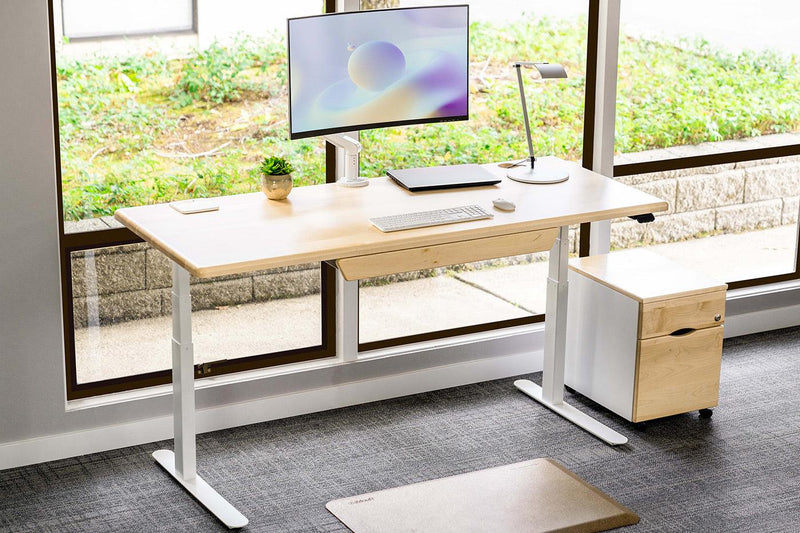
Are you tired of stiff legs, back pain, and the typical fatigue that comes after lunch?
Most people buy a standing desk so they can get rid of sitting a lot, but then they overdo standing. The problem is not about standing, it is about duration and balance. If timing is wrong, the benefit becomes a loss.
In this article, we will explain how long should you stand at a standing desk, when to sit, and when to move, and how the body gets daily support with proper setup without burnout. So you can work smart, not hard, and your body can be saved from long term damage.
Introduction to Standing Desks
The purpose of standing is simple. They break continuous sitting. This is not magical furniture that removes all health problems. If you understand how long you stand at a standing desk matters, then you've won half of the battle.
Adjustable standing desks encourage movement, increase posture awareness, and keep energy stable. But if you stand for long hours, then the benefits become zero. Quality desks are more reliable, specially USA made standing desks that offer stability and adjustability. A standing desk is a tool, and a tool is useless without discipline
Benefits of Using Standing Desks
Standing desks have real benefits, but they should not be exaggerated. First of all, it improves your posture because you do not lock your spine in a single position. Blood circulation becomes better, which reduces energy crashes. Another benefit is that your mind stays more alert. Switching directly from sitting to standing gives a wake up signal to the body.
Scientific research states that a controlled standing time is good for both metabolic health and comfort. But, keep in mind, you get the benefits only when you understand how long should you stand at a standing desk, but not only keep standing. For best results, short breaks, integrating slight movement with standing, are important.
Understanding the Risks of Overusing Standing Desks
Standing for long hours is just as bad as sitting for long hours. If you continuously keep standing, then foot pain, lower back pressure, and fatigue become common. The body does not like static positions. People often ask, how long should you stand at a standing desk, but the answer is not a fixed number of hours. Joints and muscles go into stress mode with overuse.
Standing does not mean moving. If you are not moving, then you are still frozen in a single place. That's why smart desk use is important. The goal of standing desks is to improve comfort, not to take an endurance test. Smart standing means balance, movement, and listening to body signals, but not to push yourself more.
Determining the Right Desk Height
If the desk height is wrong, then no matter how perfect your routine is, everything will be a waste. The basic rule of a standing desk is that the height should be adjusted according to the body height, not the body should adjust according to the desk.
In a standing position, elbows should be roughly at a 90-degree angle. Shoulders should be completely relaxed. The wrists should be in a straight position, neither bent up nor down. When desk height is wrong, people usually ask only one thing: how long should you stand at a standing desk. The real problem is not standing, but it is the setup.
For tall people, it is important because standard desk heights do not work for them. That is why height specific standing desk ergonomics for tall people are very important. A correct height naturally makes standing time comfortable and sustainable.
Setting Your Monitor at an Appropriate Eye Level
People often ignore the monitor position, but this is the biggest factor in neck health. Instead of having a standing desk, if the screen is in the wrong place, then discomfort is guaranteed. The ideal position is for the screen to be at your eye level or slightly down. Your head should remain neutral, neither tilted up nor bent down.
If the monitor is not adjusted, then it causes neck and upper back strain. Then people blame standing, but the real problem is the screen. Usually, how long should you stand at a standing desk is not the reason for this discomfort, but it is that you are looking at the wrong angle. Monitor arms or adjustable stands help a lot at this point. Fix your screen. The neck will feel relaxed automatically.
Balancing Sitting and Standing: The 20/8/2 Rule
If you are confused about how to keep a balance between sitting and standing, then the 20/8/2 rule is a simple solution. It is easy to follow this rule, and it is safe for the body. This rule says: sit for 20 minutes, stand for 8 minutes, and move for 2 minutes.
The system clearly defines how long should you stand at a standing desk without overthinking. You do not have to guess while watching a clock. 8 minutes of standing activates the body, but not too much that it feels tired. 2 minutes of movement resets the blood flow and relaxes the muscles. Movement means a walk or a light stretch.
With this routine, you understand how long you should stand at a sit stand desk without pain and fatigue. This rule works for both beginners and experienced users. Simple systems are more effective because the body can easily follow them.
Optimal Sitting-to-Standing Ratios
A standing desk does not mean that you keep standing for half a day. The ideal ratio of sitting to standing is usually 1:1 or 2:1, which is considered a balance for the body. This means standing for 15 to 30 minutes after every 30 minutes of sitting is enough. Standing more than this is not important, and sometimes it can cause damage.
The best approach for beginners is to start standing for 15 minutes per hour. The body needs time to adapt. If you initially keep standing for a long time, then it will cause fatigue. If you are thinking daily about how long should you work at a standing desk, then remember intervals are more important than total hours. Small sessions are more suitable for the body. Consistency is the most important factor. Intensity comes later.
Utilizing Anti-Fatigue Mats for Comfort
Standing directly on a hard floor is a common mistake of standing desk users. No matter how good the desk is, if it is not supported from below, then the feet and knees become tired quickly. Anti fatigue mats distribute pressure evenly and allow the body to move slightly. These micro movements make blood circulation better and reduce stiffness.
Standing without a mat quickly becomes uncomfortable. Then people think that the desk is not working for them, but the real problem is the floor. By using anti fatigue mats, you naturally understand how long should you stand at a standing desk without pain. Standing feels smooth and relaxed. This is a small thing, but it has a big impact. If you are using a standing desk, then a mat is not optional; it is important.
Ergonomic Accessories to Consider
A standing desk alone is not a complete setup. If there are some ergonomic accessories with it, then the experience is much better. Footrests help in changing posture and make weight shifting easy. Monitor arms help to set the screen at the exact position. Keyboard trays keep the wrists in a neutral position, which is important for long term comfort.
These accessories don’t make the setup complicated, but they increase the comfort. When you get comfort, using a standing desk on a daily basis becomes easy. If accessories are ignored, then standing time naturally looks less, but fatigue comes quickly. When comfort comes, then it becomes a habit. Otherwise, it only remains as an expensive showpiece.
Importance of Regular Movement Breaks
Light Stretching Exercises
Light stretching exercises are very effective for standing desk users. Their purpose is to keep the body loose but not exhaust the muscles. Simple stretches like calf raises, hamstring stretch, shoulder rolls, and neck rotations help a lot. These exercises improve blood flow and break stiffness.
The best time to do stretching is when you are switching between standing and sitting. This way, the body adjusts smoothly. Then, intense stretching is not important. Light and controlled moments are enough. If the body feels more relaxed after stretching, then you are going in the right direction. Making stretching a habit makes how long should you stand at a standing desk naturally manageable.
Listening to Your Body's Signals
The body always gives a signal, but we ignore it. Foot pain, back tightness, and neck stiffness are not random. If legs are numb, then movement is important. If you are feeling pressure in your lower back, then it could be due time to sit. The body gives clear signals; we just need to understand.
Usually, people follow rules and forget that everybody is different. How long should you stand at a standing desk is not the same every day. Some days it is comfortable to stand for long hours, and some days for less time. This is completely normal. Accepting the feedback of the body is a strong formula for long term comfort.
Incorporating Light Exercises into Your Routine
Light exercises do not mean sweating or heavy workouts. Small exercises are effective with a standing desk. Heel raises, ankle rotations, or slow marching movements improve circulation. These exercises keep muscles active and delay fatigue.
The benefit of these exercises is that they do not disturb focus. You can do them even when you're on a call. This way, the body gets continuous movement. Light exercises make the standing posture active, not static. When the body keeps moving, then how long should you stand at a standing desk does not seem heavy. Adding these exercises naturally to your routine is enough. It does not need more planning.
How to Manage Fatigue Effectively
Fatigue does not mean that a standing desk is not working for you. Fatigue is a signal that something important needs to be adjusted. First of all, check your standing time. Maybe you are standing for a long time. Reset the balance between sitting and standing.
Then check your footwear and floor support. Anti-fatigue mats, proper shoes, and short movement breaks reduce fatigue. Sometimes adjusting desk height or monitor position is enough.
If you feel tired daily, then it does not mean that decreasing how long should you stand at a standing desk is the solution. Sometimes it is more important to improve the quality of standing time. Do not ignore fatigue. Handle it by considering it as feedback.
Enhancing Productivity with Proper Desk Setup
Productivity is directly connected to the body’s comfort level. When the body is relaxed then the mind naturally remains more focused. Proper desk setup means that you do not think about posture again. Screen, keyboard, and desk height should adjust with the body. The benefit of a standing desk comes out when discomfort goes in the background. If you are fixing posture every 10 minutes, then your focus is broken.
People often link productivity with workload, but the real problem is the setup. Once the setup is right, then how long should you stand at a standing desk is managed automatically. Comfortable setup means fewer distractions, better focus, and consistent output.
Choosing the Right Footwear for Standing
A footwear for a standing desk can make or worsen the experience. Standing with the wrong shoes becomes quickly painful. Soft soles, proper arch support, and cushioning are very important. Flat and hard shoes put extra pressure on the feet, which speeds up fatigue. If you are using an anti-fatigue mat, then barefoot or standing in socks is an option. But shoes are important on a hard floor.
Footwear directly affects how long should you stand at a standing desk. Good shoes naturally extend standing time. Do not consider shoes only as a fashion. These are ergonomic tools that affect your daily comfort.
Adjusting Your Workstation for Maximum Comfort
Workstation setup is not a one-time task. This is an ongoing process that evolves with time. Your body, workload, and routine keep changing. That is why it is important to adjust desk height, monitor position, and accessories at the same time. Small adjustments like moving the keyboard a bit forward, or backward, or slightly changing the screen height, can make a huge difference.
These changes stop discomfort. If you adjust regularly, then the question of “how long should you stand at a standing desk question” does not create tension. Your body guides you naturally. Maximum comfort does not mean perfection. It means the setup should work for you smoothly with your daily workflow.
Tips for Transitioning to a Standing Desk
Transitioning to a standing desk is not the work of one day. The body needs time to adjust; that's why starting gradually is a smart approach. In the beginning, only stand for 15-20 minutes per hour. And for the remaining time, work in a sitting position. As your body gets comfortable, increase your standing time gradually. Directly standing for long hours can cause both fatigue and pain.
Setting an alarm or a reminder is helpful so you do not forget to change posture. Use an anti fatigue mat, and comfortable footwear from the first day, this makes the transition smooth. Occupational research also states that posture variations and gradual exposure significantly reduce fatigue and joint stress. The most important thing is not to compete with your body. For everyone, how long should you stand at standing desk is different. The goal of transition is consistency, not perfection.
Balancing Sitting and Standing for Health Benefits
Keeping a balance between sitting and standing is a real health solution, so you must know how long should you stand with a standing desk. Only standing or only sitting are extremes. When you follow smart intervals, movement breaks, and a proper setup, then the body naturally feels supported.
Standing desks work best when you use it as a tool, not as a punishment. If you want to make your workflow comfortable, productive, and pain-free, then the right guidance and quality setup are important. Explore our ergonomic desks that are designed for long-term health, adjustability, and performance.
FAQs
Should you stand all day at a standing desk?
No, standing for an entire day is not healthy. Standing for long hours puts extra pressure on the feet and lower back. The best approach is to keep a balance between sitting, standing, and movement.
What exercises at a standing desk can be helpful?
Light exercises like calf raises, ankle rotations, shoulder rolls, and light marching are very helpful. These exercises improve blood circulation and reduce stiffness without disturbing the focus.
How long should I stand at my desk each day?
It does not have a fixed number, which is the same for everyone. Usually, standing for 15 to 30 minutes per hour is recommended, while the remaining time is for sitting and movement. Listening to your body signals and increasing the time gradually is the best approach.
Are standing desks good for back pain?
Yes, if used properly, a standing desk can reduce back pain. Proper desk height, correct monitor position, and regular movement breaks are very effective. With consistent use and smart posture, you will feel maximum comfort and relief.