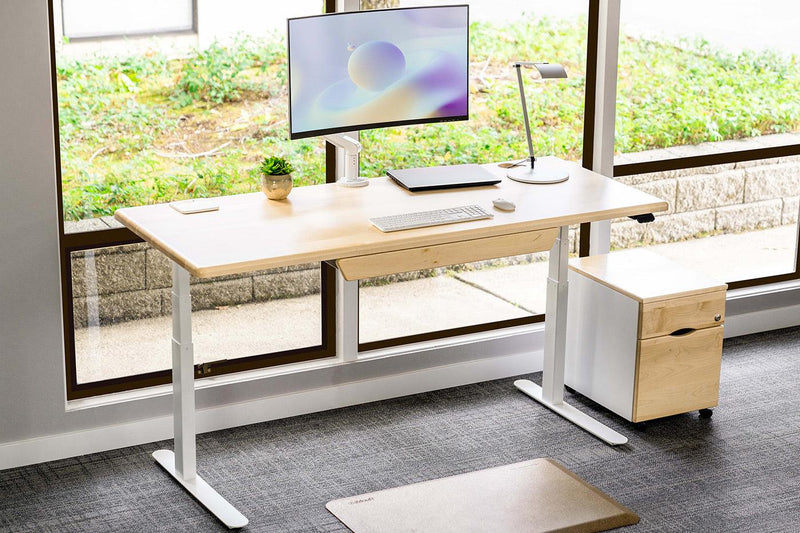
Standing desks can boost productivity by up to 46%. That is hard to ignore.
The problem is that most standing desk advice is written for offices with room to spare. A small apartment is a different situation entirely.
You are managing a space that has to sleep, cook, relax, and work, all at once.
This guide walks you through how to set up a standing desk for small spaces without sacrificing comfort, workflow, or the room itself.
Why Small Apartments Need a Different Ergonomic Setup
Working from a small apartment isn’t the same as working from a full home office. Most advice online assumes you have space to spread out. You don’t.
Your desk sits next to your couch. Sometimes your bed. Everything overlaps, and that changes how your setup should work.
Before COVID-19 pandemic, remote work was rare. Then suddenly, everyone was working from home. Small spaces had to do double duty, even if they weren’t designed for it.
That’s one reason standing desks took off. The market grew fast as people tried to fix back pain, posture, and long sitting hours.
But the challenge isn’t just physical. It’s mental too.
When your workspace blends into your living space, your brain doesn’t fully switch off. Work feels constant.
A good standing desk setup helps create a boundary. Even a small one.
But the wrong setup? It does the opposite. It makes your space feel tighter, and your day feel heavier.
Choosing Between a Desk Converter and a Full Standing Desk
Choosing between a desk converter and a full standing desk depends on your space and how you work. If your setup is tight and you already have a desk, a converter is the easier option.
Something like the iMovR ZipLift Standing Desk Converter sits on top of your current desk. It adds height without taking extra floor space and is easy to move if you need to adjust your setup.
ZipLift Standing Desk Converter
$375
Turn any desk into a sit-stand workstation in seconds. Smooth electric lift, stable dual-level design, and an ergonomic keyboard tray that reduces wrist strain without replacing your entire setup.
Height Range
Up to 20.6"
Capacity
35–45 lbs
Keyboard Tilt
+10° to -15°
Surface
35" wide workspace
But if you work long hours, a full electric standing desk makes a real difference. It gives you a larger, more stable surface and adjusts smoothly with the press of a button.
That ease matters more than people think. If switching positions takes effort, you will slowly stop doing it without even noticing.
So it really comes down to this. Less friction means better habits. The simpler your setup feels, the more likely you are to actually use it every day.
How to Measure Your Space the Right Way
Measuring before you buy is obvious advice. Measuring correctly is not.
Desk Dimensions vs Usable Space (What Most People Miss)
A 48-inch desk sounds reasonable on paper. But that number only covers the surface.
It doesn’t include the space your chair needs to roll back. Or the room you need to move around comfortably. Or how “heavy” the desk feels visually in a small room.
So the real space it takes is always bigger than you think.
A simple rule helps here. Leave about 36 inches behind your chair so you can move freely. Then keep another 12 to 18 inches clear on at least one side for walking.
Now picture that inside a 10×10 room. That “compact” 48-inch desk suddenly feels a lot less small.
How Much Standing Clearance You Actually Need
Standing takes more space than sitting. You shift, step back, adjust your posture. That all needs room.
Give yourself at least 24 to 30 inches of clear space in front of the desk. Less than that, and you’ll end up standing too close, almost leaning into the desk.
That’s not comfortable. And it defeats the whole point.
Common Measurement Mistakes in Small Rooms
Most people measure the wall and call it a day. That’s where things go wrong.
Walls don’t tell the full story. Doors open into that space. Vents, heaters, switches. They all take up room.
Measure the actual usable area, not just the width of the wall.
And think about movement. A desk might technically fit, but if it blocks your daily path, it becomes annoying fast.
You’ll bump into it. Squeeze past it. Regret it.
Measure how you live in the space, not just how the space looks.
Where to Place Your Desk in a Small Apartment
Placement determines how much space the desk feels like it takes, even more than its actual dimensions.
Wall Placement for Minimal Footprint
Place your desk against a wall if your apartment is small. No walkway needed on that side and the desk does not stick out into the middle of the room. Most people do this because it just works.
Here is what people screw up though. They push the desk totally flush with the wall. Leave two to three inches of space back there. That gap is where cables go.
Smash everything tight and your power cords, monitor cables, all of it bunches up against the wall and looks like hell. Small space already feels cramped without a cable nest making it worse.
Corner Setups That Maximize Surface Without Taking Space
A corner desk or a standard desk placed at a diagonal into a corner gives you significantly more surface area without expanding your room footprint.
The corner is usually the least functional part of a small room. Putting a desk there reclaims dead space.
The ergonomic challenge with corner setups is monitor angle. Sitting at a 45-degree angle to a flat wall means your monitor needs to face you directly, not the wall.
A monitor arm solves this completely and is essential for any corner standing desk setup.
Positioning Near Windows Without Creating Glare
Natural light reduces eye fatigue during long work sessions. But a monitor facing a window creates glare that makes that same light a liability.
The correct position is to place the desk perpendicular to the window, so light enters from the side rather than behind or in front of your screen.
This positioning also helps when you are standing. When you shift posture, your eye line changes slightly.
A perpendicular window gives you consistent, even lighting at both sit and stand heights without the need for additional window treatments.
Maintaining Walking Flow in Multi-Use Rooms
In a studio apartment or a living room that doubles as a workspace, the desk cannot block the natural path people take through the room.
When it does, every walk to the kitchen or bathroom becomes a small obstacle, and over time that friction changes how the room feels to live in.
Map the movement lines in your room before placing the desk. The path from the front door to the bedroom, from the bedroom to the kitchen, and from the couch to the window are all lines worth protecting.
Build Vertically to Save Space (The Smart Setup Strategy)
The floor plan is fixed. The vertical plane is almost always underused. A smart small-space setup builds up, not out.
Using Monitor Arms Instead of Bigger Desks
A monitor stand or built-in riser takes up desk surface. A monitor arm takes up none. Swapping a monitor stand for a clamp-mounted arm like the iMovR EcoStand immediately frees up six to twelve inches of desk depth, which in a small setup is the difference between a functional work surface and a cluttered one.
Echo Single Monitor Arm
$150
Clear your desk in seconds and bring your screen to eye level. Smooth gas-spring movement, solid stability, and clean cable management—built for everyday work setups.
Weight Support
2.2–19.8 lbs
Height Range
16" adjustability
Tilt
±90° flexibility
Mount
Clamp + grommet
Monitor arms also make ergonomics adjustable in a way that stands do not. As you shift from sitting to standing, you can reposition the screen for proper eye-level alignment at each height.
That matters more in a small space where you cannot compensate by moving your chair or stepping back significantly.
Wall Shelves vs Drawers: What Works Better
Drawers require the chair to clear them when open, which eats floor space. Wall shelves add storage without any floor footprint at all. In a small apartment, that distinction matters.
Floating shelves above the desk keep reference materials, notebooks, and peripherals within reach without adding furniture to the room.
The key is keeping those shelves at arm-reach height, no higher than 18 inches above your standing desk height, so you are not straining to reach things you use regularly.
Keeping Your Desktop Minimal Without Losing Functionality
A cluttered desk in a small room amplifies every other space problem. Because the desk is visible from almost everywhere in a studio or small apartment, what sits on it affects how the entire room feels. A clean desk makes the room feel larger. A messy one makes it feel like a storage unit.
The practical rule is this: only items used daily stay on the desk surface. Everything else goes on shelves, in drawers, or off the desk entirely.
A single monitor, a keyboard, a mouse, and a small notepad is a complete, functional setup for most remote workers.
Cable Management for Clean, Compact Workspaces
Cable clutter hits harder in a small room. There’s nowhere to hide it. A few messy wires can make your whole setup feel chaotic.
So keep it simple.
Use the Down-Under-Along Method
Let cables drop straight down from your devices. Run them under your desk using clips or a tray. Then guide them along the wall to the power source.
That’s it. No loops. No hanging wires.
This works especially well with standing desks. The desk moves, so cables need a little slack. If you attach them too tightly to the frame, they’ll pull or get stuck.
You Don’t Need Fancy Gear Either
Just three things:
-
A cable tray under the desk
-
A few adhesive clips
-
A sleeve to bundle cables together
That’s enough for most setups.
And honestly, it’s not just about looks. In a tight space, loose cables are easy to trip over when you stand or step back. Clean cables make your space feel calmer and safer.
What to Avoid in a Small Standing Desk Setup
Small spaces don’t forgive bad choices. One wrong piece and the whole room feels off.
Skip oversized desks. A big desk might look impressive, but in a small room, it takes over everything. Suddenly, your entire space revolves around it.
Stick to something around 48 inches wide. It’s enough. Your room will breathe again.
Avoid bulky storage under the desk. That cabinet might seem useful, but it ruins leg space. You’ll end up standing at weird angles, which defeats the whole point of a standing desk.
Keep the space underneath clear. Put storage on the wall instead.
Don’t rush into a dual-monitor setup. Two monitors sound productive. In a small setup, they eat space, add cables, and crowd your view.
If you really need more screen space, go for one ultrawide monitor. Cleaner, simpler, less mess.
Watch your visual clutter. Heavy desks, dark colors, too many accessories. It all adds noise.
Go light. Keep it minimal. Let your setup blend in instead of shouting for attention.
How to Use a Standing Desk When You Have Limited Room
Having the right setup is only half the equation. How you use a standing desk in a small apartment is what determines whether it actually helps you.
A Practical Sit-Stand Routine for Small Spaces
The most evidence-backed ratio for sit-stand work is roughly 1:1, alternating every 30 to 45 minutes.
In a small apartment, that routine benefits from a timer or a preset schedule, because unlike an office, there are fewer natural prompts to move, no meetings to walk to, no coffee room down the hall.
Set two desk height memory presets: one for your seated ergonomic height and one for your standing height.
The goal is that switching between them takes one button press and under five seconds. When switching is that easy, people actually do it.
Micro-Movements That Replace Walking
In a standard office, people walk to meetings, to the printer, to a colleague's desk. In a small apartment, those movements disappear. That matters because it is not just the standing that improves health outcomes, it is the movement.
Micro-movements at the desk compensate for that lost activity. Calf raises while standing, shifting weight from foot to foot, a 60-second stretch every hour.
How to Stay Comfortable Without Extra Equipment
A standing mat is the single most useful add-on for a small standing desk setup. It reduces fatigue in the feet and lower back during standing periods, which is what allows people to stand longer before needing to sit.
The iMovR standing mats are designed specifically for home office dimensions and take up minimal floor space.
EcoLast Hybrid Chair Mat
$300–$360
A next-level standing surface that protects your feet when you stand and supports your chair when you sit. No constant repositioning, no worn-out plastic mats—just smooth, stable movement all day.
Material
Solid polyurethane
Thickness
3/4 inch support
Function
Sit + stand hybrid
Durability
10-year warranty
Beyond the mat, proper footwear matters more than most people realize. Standing barefoot or in socks on a hard floor for 45 minutes is uncomfortable enough that it will cut your standing time in half, regardless of how good the desk is.
Real Setup Ideas for Different Small Spaces
These are practical configurations, not aspirational design photos.
Studio Apartment Setup (Minimal + Flexible)
In a studio, everything shares one room. Your desk sits next to your bed, maybe even your kitchen.
So it needs to stay low-key.
Go for a 40–42 inch standing desk against the longest wall. Add a single monitor on an arm, plus a wireless keyboard and mouse you can tuck away.
Keep the chair simple. It should slide in or fold away easily.
If you move around a lot, something like the ZipLift Nomad Standing Desk fits well. Easy to adjust, easy to live with.
Bedroom Corner Workstation
Corners are wasted space. Use them.
Place a 48-inch desk at a slight angle into the corner. It opens up the room and still gives you enough working space.
Add a couple of shelves above for storage. Keep the floor clear.
One more thing. Create a small separation between work and rest.
A lamp, a shelf, even a different light tone helps your brain switch off when you're done.
Living Room Hybrid Setup (Work + Life in One Space)
This setup needs to switch fast. Work mode to chill mode.
Keep the desk against a wall. Use a monitor arm so you can push the screen back when you're done.
Lighting does most of the work here.
A focused desk lamp signals it's time to work. Turn it off, and the space feels like a living room again.
Simple setup. Easy reset.
Best Standing Desk Options for Small Apartments
44% of companies already provide or subsidize standing desks.
For remote workers not covered by that, the personal investment has become more common and more justified.

Compact Desk Converters for Shared Spaces
Desk converters are the right call when you share a desk, rent your apartment and cannot modify it, or need the flexibility to remove the standing function entirely.
The iMovR ZipLift is designed for exactly this situation. It fits desks as narrow as 24 inches, lifts smoothly to standing height, and folds flat when not needed.
For a work from home standing desk situation where the desk doubles as a dining table or shared surface, a converter that can be moved in under 10 seconds is a practical necessity, not a compromise.
Small Electric Standing Desks (40-48 Inch Range)
A 40-to-48-inch electric standing desk is the sweet spot for small apartments. Wide enough for a full work setup, narrow enough to fit in rooms where a standard 60-inch desk would be impossible.
The iMovR Lander Desk starts at 42 inches and adjusts from 24.5 to 50 inches in height, covering both seated and standing positions for most adults.
The motor quality on budget electric desks is a real differentiator. A desk that vibrates or drifts at standing height adds friction to the sit-stand routine and becomes a source of frustration within weeks.
Flexible and DIY Options for Tight Layouts
A lightweight standing desk or portable sit-stand solution makes sense for people in temporary housing, frequent movers, or anyone who is not ready to commit to a full setup.
Adjustable-height folding desks in the 36-to-40-inch range are available in a compact desk format that can be stored upright against a wall when not in use.
The trade-off is stability. A portable sit-stand solution will never match the rigidity of a floor-standing electric desk. For light laptop use, that is acceptable.
For a full monitor-and-keyboard setup, stability matters enough that a semi-permanent solution is worth the added footprint.
Conclusion
A standing desk for small spaces is not a scaled-down version of a regular standing desk setup. It requires different decisions about placement, sizing, storage, and transition mechanics, and it rewards careful planning in ways that a generous office space does not.
Build a setup where the right choice is also the effortless one, and the ergonomic benefits follow naturally.
If you are ready to find a compact desk that actually fits your space, iMovR's lineup of small-footprint standing desks is a practical place to start. Measure your space first. Then choose a desk built for it.