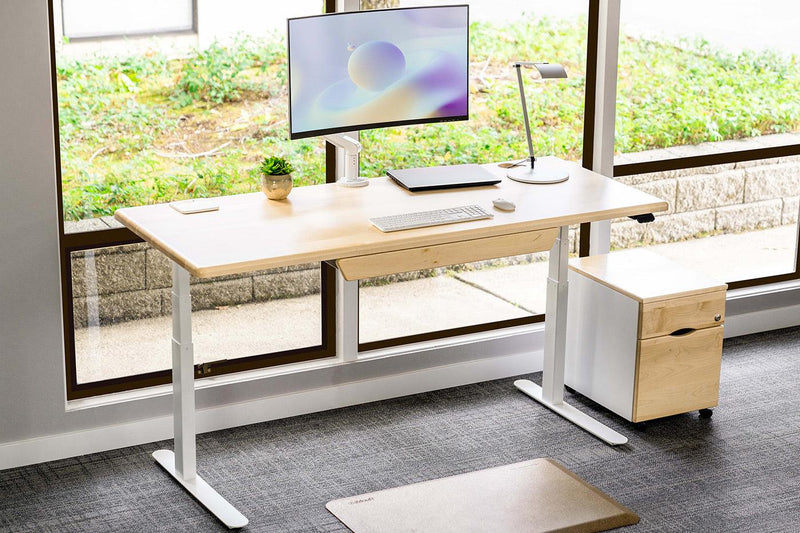
Standing desk use grew by 7% last year, which explains the growing focus on the U shape vs L-shaped standing desk choice.
Office workers are no longer choosing desks based on looks alone. They want space. Comfort. Flow. And a setup that actually supports a full eight-hour workday.
So which one works better for a modern 9 to 5 job?
That is exactly what this guide answers.
Why Desk Shape Matters More Than Most Office Workers Realize
Desk shape is not a cosmetic decision. It directly affects posture, reach, workflow, and mental fatigue. And for office workers who spend most of the day in front of screens, those factors add up fast.
A straight desk limits movement. A poorly planned corner desk creates dead zones. And a desk that cannot support monitors, paperwork, and devices at the same time forces constant micro-adjustments. Over time, those adjustments hurt productivity.
That is why the u shaped desk vs l shaped desk comparison matters so much for modern offices.
Both shapes are designed to maximize workspace. Both can be configured as sit-stand desks. But they support very different workstyles.
One favors immersion and control.
The other favors flexibility and space efficiency.
And for full-time office workers, that difference shows up every single day.
Understanding the L-Shaped Standing Desk Setup
Think of an L-shaped standing desk as two tables joined at a 90-degree angle. Most people shove them into corners because that's the obvious spot, but you don't have to.
Plenty of folks put them out in the middle of a room, especially in those open-plan offices where walls aren't really an option anyway.
This desk style is popular because it creates two distinct zones. One side is usually screen-focused. The other supports paperwork, laptops, or accessories.
For office workers who juggle digital and physical tasks, that separation helps maintain focus.
How L-Shaped Standing Desks Support Daily Office Work
Most professionals using a standing desk l shaped setup arrange it like this:
-
Primary surface for monitor and keyboard
-
Secondary surface for documents or laptop
-
Corner section for accessories or storage
This layout reduces clutter on the main work surface. It also keeps frequently used tools within arm’s reach.
And because L-shaped desks work well in corners, they help optimize smaller office spaces.
Then again, space efficiency comes with trade-offs.
Limitations of L-Shaped Standing Desks
An L-shaped desk gives you two surfaces, but not full wraparound access. You still rotate your chair or body to move between zones. For some users, that movement feels natural. For others, it interrupts workflow.
Another limitation is weight distribution. When using dual monitors, the primary arm of the desk often carries more load. Desk stability and materials matter more here than with straight desks.
Cable management can also become tricky, especially when monitors, laptops, and accessories sit on separate arms.
So while L-shaped desks work well for many office workers, they are not always ideal for those handling multiple workflows at once.
That brings us to the alternative.
What Makes a U-Shaped Standing Desk Different
A U-shaped standing desk wraps around the user on three sides. It creates an immersive workstation where everything stays within reach.
For office workers who manage emails, data, reports, meetings, and creative work simultaneously, this setup changes how the workday feels.
Instead of turning away from tasks, you pivot slightly. Instead of stacking tools, you spread them logically.
That is the defining advantage in the u shaped vs l shaped desk debate.
How U-Shaped Desks Support Complex Workflows
U-shaped desks are commonly -used by professionals who rely on:
-
Dual or triple monitors
-
Heavy paperwork
-
Dedicated device zones
-
High task switching
Each surface serves a purpose. One side for monitors. One for writing or reviewing. One for reference materials or secondary devices.
This structure reduces cognitive load. You spend less time searching and repositioning. And more time actually working.
And that is the whole point.
Space Requirements and Office Layout Considerations
Desk shape determines room flow. And office workers often overlook this until installation day.
An L-shaped standing desk fits well in:
-
Small offices
-
Home offices
-
Corner spaces
-
Shared work environments
It uses vertical space efficiently and leaves the center of the room open.
A U-shaped standing desk, on the other hand, requires more floor space. It works best in:
-
Dedicated offices
-
Executive workspaces
-
Large home offices
-
Private workstations
Trying to squeeze a U-shaped desk into a tight room leads to cramped movement and poor ergonomics.
So when comparing u shaped vs l-shaped standing desk options, room size must be evaluated first. Not last.
Ergonomics: Posture, Reach, and Movement
The standing desk thing has become this huge debate, but honestly, that's not where you should be focusing your energy. The real culprit behind your back pain and fatigue?
You spend eight or nine hours constantly reaching across your workspace, twisting yourself into weird positions, and staying locked in poses that no human spine should have to deal with for that long.
An L-shaped desk makes you swivel slightly when you're moving between different work zones. Sure, it's a small shift, but that's actually all you need to avoid getting cemented into the same posture for hours on end.
As long as you're not contorting yourself, that little bit of shifting around actually helps.
Now a U-shaped setup? That's about bringing everything close.
You don't have to stretch or lean weird to grab what you need, it's all right there in your comfort zone. Some people swear by this because they never have to overextend.
For office workers with long screen hours, this matters.
Poor reach patterns contribute to:
-
Neck tension
-
Shoulder fatigue
-
Lower back discomfort
That is why ergonomics is a central factor in the u shaped vs l shaped standing desk decision.
Productivity and Workflow Impact
Productivity is about momentum. Desk shape either supports it or disrupts it.
With an L-shaped desk, workflow feels segmented. One zone for one task. Another for something else. This works well for structured workdays.
With a U-shaped desk, workflow feels continuous. Tasks flow across surfaces without interruption.
So which improves productivity?
It depends on the job.
Data analysts, designers, and operations managers often benefit from U-shaped desks. Administrative roles, general office staff, and home office users often prefer L-shaped desks.
That distinction matters more than desk aesthetics.
Monitor Setup and Screen Management
Monitor placement can make or break a standing desk setup.
An L-shaped desk supports:
-
Single or dual monitors
-
Corner-mounted arms
-
Secondary laptop stations
But alignment becomes important. Poor angles lead to neck rotation.
A U-shaped desk supports:
-
Dual or triple monitors
-
Centered viewing angles
-
Dedicated reference screens
This makes U-shaped desks popular among users who rely heavily on multiple displays.
In the u shaped vs l shaped desk comparison, screen-heavy roles lean toward U-shaped designs.
Storage, Organization, and Accessories
Storage is where desk shape differences become obvious.
L-shaped desks typically include:
-
Corner drawers
-
Side pedestals
-
Under-desk storage
U-shaped desks offer more surface storage. You can organize tools by task instead of stacking them vertically.
But too much surface can lead to clutter if not managed properly.
That is why materials, drawer placement, and organization systems matter regardless of shape.
Materials, Stability, and Build Quality
Standing desks endure more mechanical stress than fixed desks. Lift motors, frames, and materials determine longevity.
High-quality standing desks use:
-
Solid wood or high-pressure laminate
-
Steel frames
-
Precision lift systems
iMovR desks are built with commercial-grade materials designed for daily use. And that matters more for U-shaped desks due to increased surface area and weight.
Poor build quality shows faster on larger desks.
Always evaluate materials before choosing between u shaped vs l-shaped standing desk options.
Cost Comparison and Value Over Time
Price varies widely based on size, materials, and customization.
L-shaped standing desks generally cost less upfront. They use fewer components and smaller surfaces.
U-shaped standing desks cost more but deliver greater functionality for complex workflows.
For office workers investing in long-term comfort and productivity, value matters more than sticker price.
A desk that prevents fatigue pays for itself.
Which Desk Works Best for Different Office Roles
Here is a quick role-based breakdown.
L-shaped desk:
-
Administrative roles
-
General office work
-
Compact home offices
U-shaped desk
-
Managers and executives
-
Analysts and designers
-
Heavy multitaskers
Choosing the right shape depends on how you actually work, not how the desk looks online.
L-Shaped vs U-Shaped Desks for Home Offices
Home offices add another layer. Space constraints, shared rooms, and aesthetics matter.
L-shaped desks integrate well into home environments. They feel less imposing.
U-shaped desks dominate a room. That is good for focus but not always for shared living spaces.
That is why many home office workers lean toward standing l shape desk setups.
Final Comparison: U Shape vs L Shaped Standing Desk
When comparing u shape vs l-shaped standing desk setups, there is no universal winner.
There is only the right fit.
L-shaped desks favor flexibility and space efficiency.
U-shaped desks favor immersion and workflow control.
Office workers who understand their needs make better choices. And better choices lead to better workdays.
Conclusion
Obviously you need somewhere to set up your laptop, but here's what people miss, the way your desk is arranged has a direct impact on how you hold yourself, whether you can actually concentrate, and how productive you are over eight hours.
Trying to decide between U-shaped or L-shaped?
You're basically mapping out your entire workflow. The U-shape gives you maximum surface area, everything's close by, nothing's out of reach. The L-shape takes up less room and won't make a smaller office feel cluttered.
Start by measuring your space. Be realistic about what actually fits. After that, think about your work style.
Are you the type who needs papers, monitors, and projects spread everywhere? Or do you prefer a cleaner setup where you tackle one thing at a time?
Get the desk situation right, and the rest of your office setup becomes way easier to figure out.
If desk shape is slowing you down, it is time to fix it.
Find your ideal u shaped desk vs l shaped desk with iMovR’s professional-grade standing desks.