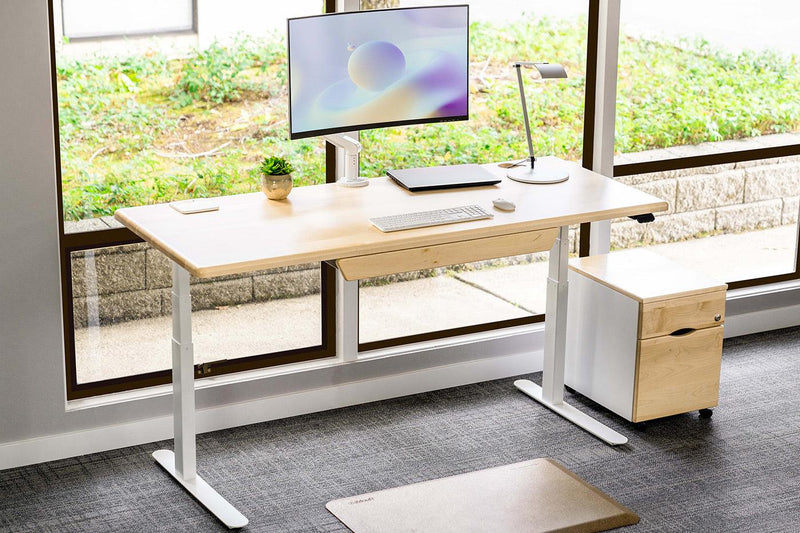
The average employee gets just 75 to 175 square feet of office space.
That is barely the size of a large walk-in closet. And most of that space is configured in a way that slowly works against the person sitting in it.
Office setup mistakes do not come with warning labels. They do not hurt immediately or tank your output overnight. They build quietly, through small daily friction, until you are fatigued by noon, distracted by afternoon, and blaming your workload by evening.
In this article, you will know exactly which office setup mistakes are draining your energy, why each one happens, and the specific fix for each one.
#1 Desk Height That Forces Bad Posture
Desk height is the most common bad desk ergonomics mistake in any office, and it is also the easiest to fix. When your desk sits too high, your shoulders lift and hold that lifted position for the entire workday.
You probably do not notice it at 9 AM, but by 2 PM your traps are burning, your neck is tight, and you are blaming the stress of the day.
When your desk sits too low, the opposite happens. Your spine rounds forward as your body tries to compensate, putting sustained pressure on your lumbar discs in a position they were not designed to hold for eight hours. That is how "just sitting at a desk" quietly becomes a physical injury over time.
What the Right Desk Height Actually Looks Like
The rule is simple: your elbows should sit at roughly 90 degrees while your forearms rest flat and parallel to the floor. But most standard desks are manufactured for a person around 5 feet 10 inches tall.
So anyone shorter or taller is working against their own skeleton, every single hour, without realizing it. Stretching does not fix a structural mismatch.
Height-adjustable desks solve this because they adapt to your body instead of asking your body to adapt to them.
When working with clients on their workstation configurations, adjusting desk height alone reduced reported shoulder and neck fatigue within the first week of the change.
It is a five-minute fix with months of payoff. Browse iMovR's height-adjustable desk lineup to find the right fit for your frame.
#2 Monitor Placement That Slowly Damages Your Neck
Monitor setup problems cause a large share of chronic neck and upper back pain in desk workers, and most people never connect the two.
So they buy a new chair. Or try a new pillow. The screen stays exactly where it is, too low and too close, doing the same damage every single workday.
For every inch your head moves forward from a neutral position, the effective load on your cervical spine increases by roughly 10 pounds.
Most monitors sit 4 to 6 inches below the ideal eye level. That is 40 to 60 pounds of extra spinal load, all day, building slowly into something that eventually requires physical therapy.
The Screen Distance Problem Nobody Talks About
Your eyes should land naturally on the top third of the screen when you look straight ahead. The screen itself should sit at roughly arm's length from your face. Most people push monitors flat against the wall or leave them sitting directly on the desk surface, which puts them in exactly the wrong position for both height and distance simultaneously.
That combination is one of the most common office setup mistakes in home and corporate offices alike.
And yet, the fix costs almost nothing. A monitor arm or a basic monitor riser repositions the screen in under 10 minutes and eliminates the forward head posture that makes your neck feel wrecked by Wednesday afternoon.
Fixing monitor placement alone often clears up eye strain that workers had been blaming on screen time for years.
#3 The Static Sitting Trap
But here is the thing: even a perfectly configured ergonomic setup causes physical fatigue if you sit still in it for too long. The human body was not designed for sustained static positions.
It does not matter how good your posture is. Hold any position long enough and circulation slows, spinal discs compress, and your focus drops whether you notice it or not.
Prolonged sitting reduces cognitive performance independently of how much you exercise outside of work hours.
So your morning run does not cancel out six consecutive hours of motionless sitting at your desk. The sitting itself is the problem, not just the quality of the seat.
Why Standing Desks Actually Work
The real value of a sit-stand desk is not that standing is inherently superior to sitting. It is that switching between the two, roughly every 25 to 30 minutes, keeps the body active enough to maintain blood flow and alertness throughout the day.
Desks like the iMovR Lander series include programmable height memory so you can switch positions in about three seconds without interrupting your workflow.
That is why frequent posture changes beat perfect static posture every time. Movement is the point.

iMovR Executive Workstations
Lander Executive
Standing Desk
Handcrafted solid wood meets executive-grade performance. Designed for refined workspaces that demand premium materials, exceptional stability, and a desk presence that instantly elevates the room.
Solid wood craftsmanship · Built for decades
#4 Keyboard and Mouse Positioned Too Far Away
Reaching forward to type is one of the most persistent workspace setup errors in any office, and it is difficult to catch because the distance involved usually looks completely normal.
Two or three extra inches of reach does not look like a problem. But those inches force your shoulders into a slightly extended, open position for every hour you spend at the desk.
Over weeks, that forward reach creates progressive shoulder fatigue, bicep tension, and the kind of wrist strain that eventually develops into a repetitive stress injury. It is a slow accumulation problem, not a sharp sudden one.
That is exactly why people do not connect the shoulder pain to the keyboard placement until the damage is already established.
Your keyboard and mouse should sit close enough that your elbows hang naturally at your sides and your wrists stay flat and neutral while typing.
If you have pulled the keyboard back to create more open desk space, you have traded your long-term physical comfort for a few extra inches of surface area.
A keyboard tray mounted below the desk surface restores correct positioning without giving up any usable space above it.
#5 Cable Clutter That Creates Visual Stress
Tangled cables behind your monitor are not just an eyesore. They are a low-level cognitive tax you pay all day without ever being aware of it.
Physical clutter in your visual field competes directly for neural processing resources, which reduces sustained focus and increases mental fatigue across the workday.
So every time your eyes drift toward that cable nest, your brain spends a fraction of a second processing it as visual noise. It happens dozens of times per hour. That is one of the office setup mistakes that most ergonomics guides skip entirely because it does not fit neatly into the physical comfort category.
Routing cables through management trays, bundling them with velcro ties, and keeping them out of your primary sightline takes about 20 minutes of actual work.
And it pays back a small but consistent dividend in reduced workspace fatigue for every hour you sit at that desk afterward. Twenty minutes now, hundreds of hours of cleaner focus over the course of a year.
#6 Poor Lighting and Screen Glare
Overhead fluorescent lighting positioned directly above your monitor creates glare on the screen that forces your eyes into constant micro-adjustments throughout the day.
You will not notice it happening in real time. But by mid-afternoon, you have a specific kind of tired-eyes headache that feels like general fatigue and gets blamed on sleep or stress instead of the lighting.
This is one of those office setup mistakes that builds entirely invisibly. The discomfort starts small, accumulates gradually, and almost never gets traced back to the overhead fixtures.
It is a posture mistake office workers make with their lighting setup the same way they make it with their chair: they accept the default and assume it must be fine.
The Fix Is Simpler Than You Think
Position your monitor perpendicular to any windows to eliminate direct glare at the source. Add a desk lamp with adjustable color temperature so you control the light falling on your work surface rather than relying entirely on harsh overhead fixtures.
The goal is even, diffuse light that removes reflections and shadows from your entire working field. That combination solves most screen glare problems without replacing a single fixture in the room.
#7 Wrong Desk Orientation
A desk facing a blank wall reduces your effective visual field to about two feet of painted surface. That sounds like a minor inconvenience.
But humans respond to environmental stimulation, and a flat, close visual field gives the brain almost nothing to passively process during the workday.
The result is a subtle but real drop in ambient alertness that makes focused work feel heavier and duller than it actually needs to be.
Orienting your desk to face an open room, a window, or even a corner angle costs nothing to change and opens up your visual field immediately.
In workspace consulting work, this consistently ranks as one of the adjustments clients feel the most quickly, despite being one of the simplest bad desk ergonomics corrections available.
The workspace shapes your mental state in ways you do not consciously register. Facing a wall narrows that state every single day.
#8 Ignoring Ergonomic Chair Adjustments
Most office chairs never get properly adjusted after someone first sits in them. Seat height, lumbar support, armrest position, and seat depth all stay at factory defaults. And factory defaults are calibrated for nobody's specific body.
That is a significant workspace setup error because a misconfigured chair introduces compensatory posture from the very first minute of every workday.
Lumbar support should press gently into the natural inward curve of your lower back, not into your mid-back or your ribcage. Armrests should allow your shoulders to drop and fully relax downward, not prop them upward or push your arms out to the sides.
Seat depth should leave two to three fingers of clearance between the front edge of the seat and the back of your knees.
Five minutes of chair adjustment prevents hours of compounding back fatigue across the week. Most people skip it because it does not feel urgent. That is exactly the trap.
#9 Lack of Movement Zones in the Workspace
Office setup mistakes are not limited to what sits on the desk surface. They include what surrounds the desk entirely.
When your chair is physically boxed in by walls, filing cabinets, or equipment on all sides, you have removed the option of movement from your environment. And the absence of that option is both physical and psychological.
When there is no visible open space nearby, you move less throughout the day, not because you made a conscious decision to stay still, but because the layout is not encouraging you to do otherwise.
Clearing even a small open area beside or behind your desk creates a movement zone that makes stretching and posture changes feel accessible rather than disruptive.
Accessible movement means more of it, which means less stiffness and clearer thinking through the back half of the workday.
#10 Overcrowded Desk Surfaces
Office workers are only truly productive for about 31% of the workday. Cluttered desk surfaces contribute to that number more than most people realize.
When the desk doubles as a storage surface, the working area shrinks and visual complexity increases, and both of those factors drive workspace fatigue steadily throughout the day.
A clean desk is not about being tidy for its own sake. It is about giving your visual system a simple, low-friction field to operate in. Items that are not part of the task you are currently working on should not sit within your primary sightline.
A monitor riser with a built-in drawer, a small tray system, or a dedicated shelf at arm's reach keeps the surface clear without removing anything you actually need during a standard workday.
#11 No Dedicated Zones for Different Tasks
Using the same desk setup for deep focused writing, video calls, and inbox management forces the brain to context-switch without any environmental cue that a mode change is happening.
This is one of the productivity office mistakes that high performers consistently identify once they start analyzing their own daily workflow patterns. The environment functions as a trigger for mental state, and a single undifferentiated workspace removes that trigger completely.
About 16% of companies are now fully remote. Remote workers feel this challenge most acutely because their entire professional day happens within one room.
Creating even a subtle spatial distinction, a separate chair angled for calls or a different desk surface position for focused writing, gives the brain the environmental cue it needs to shift modes efficiently.
Small differences in physical space produce measurable differences in cognitive output.
#12 Ignoring Temperature, Airflow, and Micro-Comfort
Temperature and airflow are the environmental variables that most office setup mistake guides ignore completely. A room running too warm increases drowsiness.
A room running too cold creates muscle tension that you will feel in your shoulders and neck by midday.
Raising office temperature from 68 to 77 degrees Fahrenheit reduced typing errors by 44% and increased output by 150%. Thermal comfort is a performance variable, not a personal preference.
Airflow matters separately from temperature. Poor ventilation allows CO2 levels to rise inside a closed room, which directly reduces alertness and compounds workspace fatigue long before you feel like you are actually short of air.
Opening a window, running a small desk fan, or improving HVAC circulation is one of the simplest fixes on this list.
And because poor-ventilation fatigue feels identical to general tiredness, it is also one of the last things people think to address.
Why Your Setup Matters More Than Your Motivation
Productivity problems are usually environmental, not motivational. That is the part most people miss entirely.
They try harder, stay later, build new morning routines, and restructure their schedules, while the desk height, monitor angle, cable clutter, and room temperature quietly drain the same energy those habits are trying to build.
The office setup mistakes keep running in the background, invisible, while the effort goes toward everything else.
Fixing your workspace does not require a full renovation or an expensive redesign. It requires identifying which of these office setup mistakes apply to your specific workstation and correcting them one at a time.
Start with desk height. It is the physical foundation every other fix builds on. Then address monitor position, keyboard placement, and lighting. You will not eliminate workspace fatigue in a single afternoon.
But you will feel a real difference by the end of the week. Browse iMovR's full lineup of height-adjustable desks and ergonomic accessories to build a setup that works for your body, your space, and your actual workday.