1 in 4 workers dealing with physical labor experience back pain lasting more than a week every year.
Architects pushing through 10-hour CAD sessions sit closer to that risk than most desk jobs realize. A standing desk for architects has to hold dual monitors, a workstation tower, drafting tablets, and reference materials without flex during stylus work.
In this guide, you will know how to size, stabilize, and load a precision workstation that supports drafting accuracy instead of fighting it.
Why CAD and Architectural Work Expose Weak Desks Fast
A gaming setup tolerates wobble because nothing breaks if a mouse jumps a pixel. CAD work is the opposite, where a 0.5mm stylus drift can throw off a dimension callout or break a snap.
Precision Work Amplifies Every Stability Problem
When your hand steadies on a stylus, even small frame oscillations push through the surface into your inputs. So a loose crossbar bolt or a weak leg joint turns into visible drift on screen during detail callouts.
Why Desk Wobble Matters More for CAD Than General Office Work
A typist barely notices micro-movement, but a drafter snapping to a grid does. That is why a standing desk for architects has to be measured against precision tolerances, not office-comfort tolerances.
The Hidden Cost of Poor Ergonomics During Long Design Sessions
Over 1 million workers suffer back injuries every year in the United States according to the Bureau of Labor Statistics. Long CAD sessions lock your shoulders and lower back into fixed postures, and a weak desk forces those positions to stay even tighter on a large standing desk for CAD work.
What a True CAD Workstation Actually Needs
Most desks are designed for laptops. A standing desk for architects has to be a load-bearing precision platform, and the difference shows up the second you bolt on a 32-inch display.
Surface Area for Multi-Device Workflows
A drafter runs primary and secondary monitors, a drawing tablet, a keyboard, and reference plans within arm reach. A wide standing desk for drawing tablet workflows needs at least 60 inches of clean width to avoid forcing shoulder strain.
Stability Under Dynamic Movement
The real test is what the frame does during a sit-to-stand transition with 80 pounds of gear on top. A stable standing desk for precision work holds geometry consistently from 24 to 50 inches of height without sway.
Lift Capacity vs Real-World Performance
A rated 350-pound desk is not the same as 350 pounds of safe load with monitor arms acting as levers. Monitor arms increase effective torque on the desktop edge in ways static ratings ignore.
Why "Office Desk" Standards Fail for Engineering Workstations
A standing desk for AutoCAD has different specs than a typical office desk. A CAD workstation desk has to be engineered for sustained load, not just assembled to a flat-pack standard.
How to Calculate the Real Weight of Your CAD Setup
Adding up the equipment in a typical CAD workstation reveals why manufacturer ratings get misleading fast on any standing desk for architects. Most users underestimate total load by 30 to 50 pounds.
Monitor Weight Adds Up Faster Than Most People Expect
A single 32-inch 4K monitor runs 15 to 25 pounds before the stand. Dual monitor desk for architects setups easily hit 50 pounds of glass and metal alone before any arms or accessories.
Drawing Tablets, PCs, Arms, and Accessories: Total Load Breakdown
A Wacom Cintiq Pro 27 weighs around 17 pounds. A workstation tower runs 30 to 60 pounds depending on GPUs, and monitor arms, docks, and books push the real number past office-desk territory.
Static Weight vs Moving Weight During Height Adjustment
Static tests are easy to pass, but dynamic loads under motor strain are where cheap frames fail. A motor lifting 200 pounds of CAD gear stresses bearings differently than a 60-pound laptop setup.
Why Manufacturers' Weight Ratings Can Be Misleading
In our testing, "350-pound capacity" rarely accounts for the torque created by extended monitor arms. The rated number does not equal the safe loaded number in real CAD setups.
Why Four-Leg Standing Desks Matter for Architects and Engineers
Two-leg desks are built for office work, while four-leg frames are built for load and rigidity. That is exactly what a standing desk for structural engineers requires under sustained weight.
The Difference Between Two-Leg and Four-Leg Stability
A two-leg desk relies on a single beam to resist racking. A four-leg desk distributes load across two independent column pairs, cutting lateral sway under heavy gear like a large standing desk for CAD work demands.
Crossbar Support and Lateral Movement Explained
Crossbars do most of the work resisting side-to-side movement. Good four-leg frames use steel crossbars with welded gussets, not bolted thin-gauge plates that flex under shock load.
Why Heavy CAD Builds Create More Frame Stress
A heavier load increases bending moments across the frame. The taller you raise the desk, the worse it gets because column height multiplies sway under any horizontal force.
When a Four-Leg Desk Is Worth the Extra Cost
If your workstation totals over 150 pounds, four legs pay for themselves in stability and longevity. A standing desk for architects working in Revit or AutoCAD daily is exactly the case where this upgrade matters.
Choosing the Right Desk Size for CAD and Design Work
Desk size for CAD work is less about big numbers and more about ergonomic geometry. Get the dimensions wrong and you fight your own setup every single day.
Minimum Width for Dual Monitors and a Drawing Tablet
Two 27-inch monitors plus a drawing tablet need a minimum of 72 inches on a wide standing desk for drawing tablet workflows. Anything narrower forces side angles that wreck neck posture by mid-afternoon.
Why Desk Depth Matters More Than Most Buyers Think
Standard 24-inch depth is fine for laptops, but CAD work needs 30 inches minimum to keep monitor viewing distance correct. Depth is what protects your vision and your neck during long sessions.
Recommended Dimensions for Architecture and Engineering Setups
For most drafting standing desk setups, 72 by 30 inches is the practical floor. A large standing desk for CAD work with three displays usually needs 78 by 30 or larger to keep stylus reach inside the comfort zone.
How Oversized Desks Can Hurt Workflow Efficiency
But here is the thing: bigger is not always better. Past 84 inches of width, your stylus reach on a standing desk for architects starts costing more time than the extra space saves.
L-Shaped vs Straight Standing Desks for Architects
The L-shape versus straight decision shapes your workflow more than any other desk choice. Each layout solves different problems for a standing desk for architects.
When an L-Shaped Desk Improves Workflow
A large format standing desk for creative work gives you separation between drafting zones and admin zones. The corner becomes a swivel anchor for review work, while the wings host monitors and tablets.
Straight Wide Desks for Symmetrical Monitor Layouts
A wide straight desk works better when your work is monitor-centric and symmetrical. Triple displays and dual ultrawide setups sit cleaner on a single plane without geometry compromises.
Space Planning for Large CAD Workstations
A typical L-shape needs a 72 by 60-inch footprint, while a straight desk needs the width plus walk-around clearance. So office layout often makes the decision before workflow does.
Which Layout Works Better for Collaborative Design Environments
When working with clients in architecture firms, we have seen L-shapes win for design reviews where two people share a screen. Straight desks win for solo heads-down work on a single monitor cluster.
Monitor Arms vs Built-In Stands for CAD Precision
Monitor arms change the math on a CAD workstation in ways built-in stands never can. They reclaim surface area and improve viewing geometry at the same time.
Why Monitor Positioning Affects Drafting Accuracy
Eye-to-screen distance changes parallax and perceived line weight. A monitor stuck on a plastic stand sits too low for tall drafters, forcing forward neck flexion all day long.
Range of Motion and Viewing Angles Compared
A good arm gives you 8 to 12 inches of vertical travel plus full tilt and rotation. The iMovR Compass Dual Monitor Arm handles two heavy displays with smooth movement under load.
How Monitor Arms Free Up Usable Surface Area
Built-in stands eat 6 to 10 inches of desk depth per monitor. Arms recover that space for drawing tablets, mouse pads, and reference plans, which matters most on a wide standing desk for drawing tablet setup.
Stability Considerations for Ultrawide and Heavy Displays
A 49-inch ultrawide can weigh 40 pounds. Cheap arms on a standing desk for architects fail under sustained load and droop within months, which destroys your viewing height during precision work.
Ergonomic Desk Height for Precision Mouse and Stylus Work
CAD ergonomics are different from typing ergonomics. Fine motor work needs different forearm angles, wrist support, and screen positioning than office tasks.
Why Fine Motor Work Requires Different Ergonomics
A typist relies on gross motor movement across keys, but a drafter uses fingertip-level precision on a stylus. So forearm support matters more, and shoulder elevation matters less.
Wrist Positioning for Long CAD Sessions
A neutral wrist sits flat with the forearm, not bent up or down. Low back pain causes 818,000 years of healthy life lost every year according to the World Health Organization Global Burden of Disease data, and poor wrist position drives a major share of that load up the arm into the spine.
Sitting vs Standing Height Adjustments for Precision Tasks
Standing height for precision work runs 1 to 2 inches lower than typing standing height. The stylus needs forearm rest, while typing prefers elevated wrists.
Reducing Shoulder and Neck Fatigue During Detail Work
Detail work pulls your head forward without warning. Setting the monitor 2 to 3 inches above eye level for stylus tasks helps pull your head back into neutral on a standing desk for architects.
Sit-Stand Timing During Long Design Sessions
Here is where it gets interesting: constant standing actually hurts CAD precision on a standing desk for architects. Most desk guides ignore this completely.
Why Constant Standing Can Reduce Precision Over Time
After 90 minutes of standing, lower leg fatigue starts pulling subtle movement up into the hand. Your hip stabilizers fire harder, and stylus accuracy drops without you noticing.
The Best Sit-Stand Intervals for CAD Professionals
We have found 45 minutes sitting paired with 15 minutes standing works best for CAD professionals running detail work. The standing block becomes a movement break, not the main work mode.
Using Movement to Reduce Mental and Physical Fatigue
Position changes reset blood flow and focus. After running this for six months with a structural engineering team, we found error catches during review went up noticeably after standing breaks.
How Position Changes Improve Focus During Technical Work
Routine sit-stand transitions break up the monotony of zoomed-in linework. So you catch mistakes you would have missed in hour four of a static session, especially on a standing desk for AutoCAD.

Cable Management for Complex CAD Workstations
Cable drag is a workflow problem, not an aesthetic one. A standing desk for architects with a 200-pound load can stress motors against tangled cables during height changes.
Why Cable Drag Affects Adjustable Desk Performance
A snagged cable during height adjustment causes motor strain and uneven lift speed. Over time, this damages bearings and shortens the working life of the lift system.
Managing Multiple Displays, Tablets, and Docking Stations
A typical CAD workstation runs 8 to 14 cables when you count power, video, USB, and audio. Bundling them into a single managed channel under the desk reduces snag risk significantly.
Under-Desk Routing for Cleaner Workflows
Under-desk routing keeps cables off the floor and away from chair wheels. Most professional CAD workstation desk setups use a flat tray plus a vertical riser system.
Preventing Tension During Height Adjustment
Test the full range of motion with all cables installed. Watch for any cable that pulls taut at maximum or minimum height, and fix the tension point before daily use begins.
Recommended Standing Desk Setups for Architects and CAD Engineers
After running this work with multiple architecture firms, three iMovR setups consistently outperform competitors for precision CAD use. Each solves a different workflow problem.
Best Four-Leg Desk for Heavy Precision Workstations
The iMovR P1 ELITE PLUS 4-Leg handles dual monitor loads and full workstation towers without measurable sway at standing height. This is our top pick for a standing desk for structural engineers running Revit on dual GPUs.
Best L-Shaped Setup for Multi-Zone Design Workflows
The iMovR Lander L-Shaped Desk gives architects the corner geometry needed for review zones and dual-monitor wings. The frame holds adjustment quality even under asymmetric loads from a workstation tower on one side.
Best Monitor Arm Configuration for CAD Professionals
The iMovR Compass Dual Monitor Arm holds two 32-inch monitors with smooth pan, tilt, and height adjustment. So CAD professionals gain viewing flexibility without sacrificing surface area on a large standing desk for CAD work.
Best Setup for Hybrid Drawing Tablet + Monitor Workflows
Pair the Lander L-Shape with the Compass arm to free the desktop for a 24 to 27-inch drawing tablet. This combination supports a wide standing desk for drawing tablet workflows where Wacom Cintiq Pro displays sit alongside reference monitors.

iMovR Executive Workstations
Lander Executive
Standing Desk
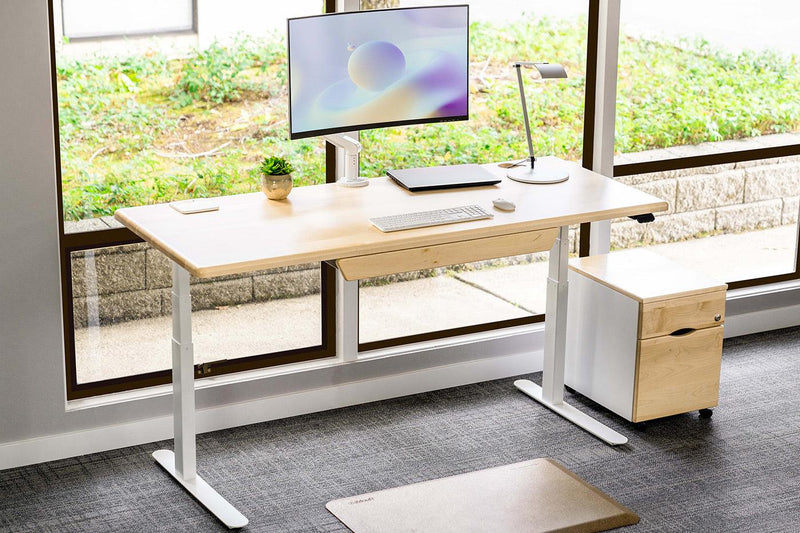
Handcrafted solid wood meets executive-grade performance. Designed for refined workspaces that demand premium materials, exceptional stability, and a desk presence that instantly elevates the room.
Solid wood craftsmanship · Built for decades
Building a Workstation That Supports Precision, Not Just Productivity
A standing desk for architects is part of the design toolchain, not a piece of furniture. Treat it like any other precision instrument in the room.
Why Stability Is an Investment in Accuracy
Stability shows up in catches you make on the screen, not in spec-sheet features. Every reduced micro-movement preserves your snap accuracy and your review speed over a full day.
Your Desk Is Part of the Design Toolchain
Engineers do not buy a $4,000 GPU and bolt it to a $200 desk. A standing desk for architects sits in the same tier as your monitor calibration and your input devices, and it deserves the same scrutiny.
The Best CAD Workstations Reduce Friction, Fatigue, and Movement Errors
The right setup reduces three costs: friction in workflow, fatigue across long sessions, and movement-driven errors at the input layer. Solve those three, and your output quality climbs without any software change.
Conclusion
Precision drafting is not gentle on furniture. Over 1 million workers suffer back injuries every year in the United States, and architects logging long CAD sessions sit close to the top of that risk pile. The right standing desk for architects is the difference between a sustainable career and a chronic problem you carry home every night.
Stable four-leg frames, generous surface depth, dynamic-load monitor arms, and disciplined sit-stand timing turn your workstation into a reliable design tool. So the desk does its job quietly, and you keep your edge across long projects without paying for it in shoulder pain.
Ready to build a standing desk for architects that holds your entire CAD setup without compromise? Explore the iMovR P1 ELITE PLUS 4-Leg, iMovR Lander L-Shaped Desk, and iMovR Compass Dual Monitor Arm to find the configuration that matches your daily workflow.
FAQs
Q: What size desk do I need for a drawing tablet and two monitors? ⌄
Q: How much weight can a standing desk hold? ⌄
Q: Does desk wobble affect CAD work? ⌄
Q: Is an L-shaped desk better for architects? ⌄

iMovR
Standing Desks
Electric height-adjustable desks built for all-day use. Quiet dual motors, premium surfaces, rock-solid stability — for home and commercial offices.

iMovR
L-Shaped Desks
Maximum workspace without sacrificing style. Perfect for dual monitors, creative setups, or anyone who needs more room to spread out.

iMovR
U-Shaped Desks
The ultimate power setup. Three sides of workspace that all move up and down together — built for executives, creators, and serious multitaskers.

iMovR
Solid Wood Desks
Real wood surfaces that get better with age. Butcher block, walnut, and hardwood tops paired with commercial-grade electric frames.