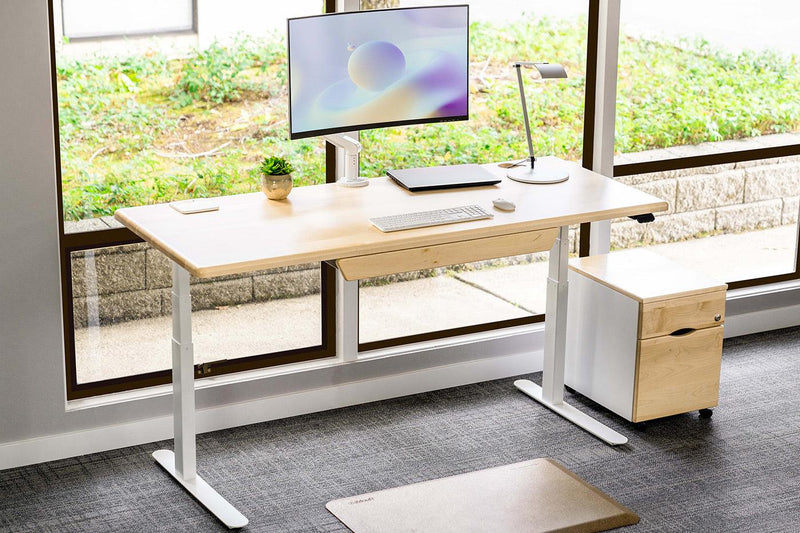
55% of freelancers feel drained, 45% hurt their backs, because of your desk. That’s why you need an L shaped computer desk.
Long work hours are no longer just tiring. They are physically expensive.
If you work eight hours a day, or more, your desk is not furniture. It is infrastructure.
This guide breaks down exactly what to know before you buy, so you avoid wasted money and daily discomfort.
Understanding the L-Shaped Desk
Take two desk surfaces, stick them together at a 90-degree corner, and you've got yourself an L-shaped desk.
Usually one side becomes your main area where the computer lives, and the other side? That's where you toss files, extra monitors, or whatever else you're working on.
It's perfect if you're bouncing between different things, running two monitors, dealing with paperwork, or keeping your computer stuff separate from where you sign documents and shuffle through files.
A lot of business owners swear by the L-shape because they can fit their screens, filing system, and a little meeting space all within arm's reach without needing a massive office.
Freelancers benefit from the clear zoning that helps switch between tasks without breaking focus.
Office workers rely on it for efficiency, especially when job roles involve data entry, analysis, and communication at the same time.
Unlike traditional straight desks, an L shaped computer desk supports workflow expansion without requiring a larger room.
You gain usable surface area while keeping everything within arm’s reach. That balance is the reason this design continues to dominate modern office planning.
Benefits of an L-Shaped Design
The biggest benefit is spatial efficiency. The desk fits naturally into corners that usually go unused.
Another major advantage is posture control. Users can rotate tasks instead of leaning forward or twisting repeatedly.
There is also a productivity benefit. Separate surfaces reduce clutter overlap. One side can stay clean for focused work, while the other handles accessories or reference materials.
That mental separation supports concentration. And that is not accidental. Workspace design directly influences cognitive load and task switching efficiency.
Assessing Your Space
Measuring Room Dimensions
Before searching for an L shaped desk buy option, measure your room properly. That means accounting for wall length, depth, door swing, and walking clearance.
Many buyers focus only on desk width. That creates problems later.
Measure from corner to usable wall edge on both sides. Then subtract space needed for chairs, drawers, and movement. A comfortable clearance is at least 36 inches behind the chair.
Also consider ceiling height if you plan to add shelves, monitor arms, or lighting. Desk ownership is not isolated. It shapes the entire room layout.
Considerations for Layout and Placement
Placement determines usability. Corner placement maximizes space efficiency, but center-room placement can work for collaborative setups or executive offices.
Pay attention to window placement. Natural light should hit the desk from the side, not directly in front or behind. That reduces glare and eye fatigue.
Electrical access matters too. A desk positioned far from outlets limits future upgrades and forces messy cable routing. Planning placement early avoids costly compromises later.
Material and Style Choices
Popular Materials
Material choice affects durability, stability, and daily experience. Good quality wood lasts forever and looks great, but you're gonna pay for it.
Laminate is cheaper and wipes down easy, though the quality really depends on what's underneath that surface layer, some hold up fine, others start sagging after a couple years.
High-quality steel frames improve weight capacity and desk rigidity. This is especially important for users with multiple monitors or heavy equipment.
Bamboo surfaces are growing in popularity due to sustainability and strength-to-weight efficiency. They also resist warping better than many wood composites.
Material is not about looks alone. It directly affects how the desk performs under daily stress.
Style Aesthetics and Workspace Alignment
Your desk should visually support your work role. Minimal designs reduce distractions. Industrial styles project authority. Softer finishes suit creative environments.
Consistency matters. When desk style aligns with lighting, seating, and storage, the workspace feels intentional rather than assembled.
That sense of order helps reduce cognitive clutter. And yes, that impacts productivity more than most people expect.
Comfort and Ergonomics
Ergonomic Design Features
An L shaped standing desk will let you sit without your body fighting you. The height has to match your build. Your legs need room and nobody wants their knees jammed against the underside all day.
And there should be enough depth so your screen isn't two feet from your eyeballs.
These days, a ton of people go for the adjustable kind. You know, the standing desk style where you can raise it up whenever you get tired of sitting.
Height adjustability reduces spinal compression and improves circulation during long work sessions.
Look for rounded edges, stable frames, and compatibility with monitor arms. Poor ergonomics do not hurt immediately. They accumulate damage silently.
Health and Productivity Benefits
Getting a desk that fits your body right cuts down on all the aches and pains. There's actual research backing this up, when your desk height and screen position are dialed in correctly, people report way less neck trouble and fewer lower back issues.
Productivity improves when discomfort drops. That is not motivational theory. It is physical reality.
When your body is supported correctly, cognitive resources stay focused on work instead of pain management.
Budget Considerations
Evaluating Price vs. Value
What actually makes a desk worth the money? How long it lasts, whether it does what you need, and if it can roll with changes down the road.
Buy some cheap thing that starts wobbling after six months or gets all beat up within a year, and guess what, you're buying another one. Plus you're dealing with a crappy workspace the whole time, which tanks your productivity anyway.
Spend more upfront on something solid, though? That desk sticks with you. New job, different setup, better monitor, it handles it. Over five or ten years, you come out way ahead.
Check how much weight the thing can actually hold, what kind of warranty they're offering, and whether the materials feel substantial or flimsy.
Although a pretty desk is nice, if you're trying to spend your money smart, those practical details matter way more.
Cost-Saving Tips
The people who know what they're doing find ways to save money without ending up with junk. Here are practical ways to stay within budget:
-
Choose modular designs
-
Skip cosmetic add-ons
-
Prioritize frame quality
-
Invest in adjustability first
Buying once costs less than buying twice. That principle applies strongly to desk selection.
Additional Functionalities
Cable Management Solutions
Cables everywhere? Total nightmare. You're constantly kicking them, they jam up your drawers, and your desk ends up looking like a nest.
Get a desk with built-in trays for wires, those little holes where cables drop through, and channels underneath to run everything neatly. Problem solved for good.
That benefit rarely gets mentioned. But it matters.
Stability on Uneven Floors
Uneven floors cause wobble. Wobble causes frustration.
Look for leveling feet or adjustable glides that compensate for floor irregularities.
Stability becomes even more critical for sit-stand desks where movement amplifies small imbalances.
Reversible Configurations
A reversible design allows the return side to switch left or right. This flexibility matters if you relocate, redesign, or change office layout.
It also improves resale value and long-term usability. Fixed-orientation desks limit future options unnecessarily.
Innovative Desk Features
Built-In Charging Stations
Integrated power outlets and USB ports reduce clutter and keep devices accessible.
This feature supports modern workflows with laptops, tablets, and phones used simultaneously.
Positioning matters. Front-access ports improve usability while maintaining clean surfaces.
Whiteboard Surfaces
Some desks include writable surfaces or removable overlays.
These support brainstorming, planning, and visual thinking without extra accessories.
For freelancers and creative professionals, this feature transforms the desk into an active thinking tool.
Standing Desk Converters
If full height adjustment is not available, converters offer partial flexibility.
They sit on top of a fixed desk and raise monitors and keyboards.
While not as effective as built-in adjustment, they provide entry-level ergonomic improvement for tight budgets.
Assembly and Setup
Understanding Assembly Requirements
Not all desks assemble equally. Some require two people, specialized tools, or extended setup time.
Check instructions before buying. Poor assembly design increases frustration and risks improper installation, which affects stability.
Modular systems with pre-installed components simplify setup and reduce error risk.
Tools and Skills Needed
You'll probably need an Allen wrench or screwdriver, most desks come with the basics. But if it's one of those heavy ones, do yourself a favor and grab a power drill.
Also, clear out some room before you start. Trying to build furniture in a cramped hallway is miserable.
And don't try to rush it. When you rush through assembly, things end up crooked or not quite tight enough, and that becomes a problem you're dealing with for years.
Customization Capabilities
Customization extends desk lifespan.
Adjustable shelves, monitor arms, keyboard trays, and privacy panels allow the desk to evolve with your work.
For gamers, options align with needs similar to an L shaped gaming desk, including monitor alignment and accessory placement.
For professionals searching “L shaped desk near me,” customization often determines final satisfaction more than size alone.
Conclusion
Choosing the right L shaped computer desk comes down to space awareness, ergonomic support, and long-term value.
When your desk fits your body and workflow, productivity improves naturally.
And that is the real goal.
If you are ready to upgrade your workspace, explore iMovR’s premium L shaped computer desk options designed for real workdays.