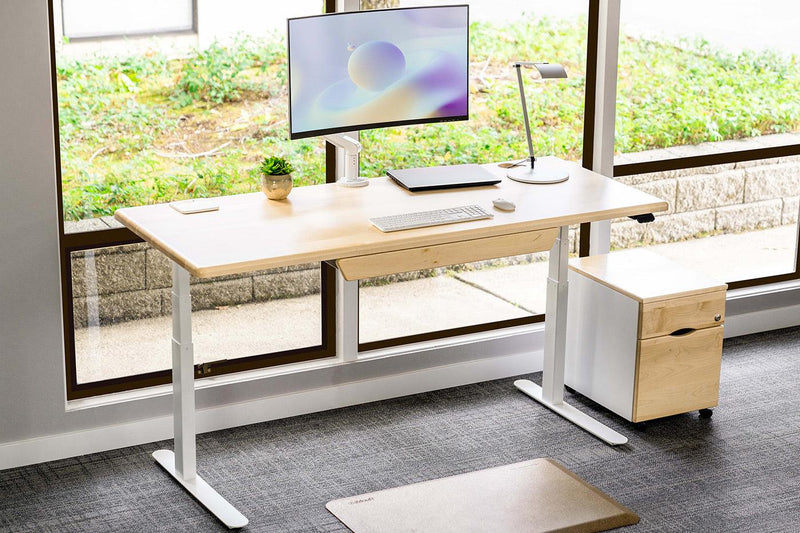
A 2021 study found that using a standing desk for 24 weeks improved fasting triglycerides and reduced insulin resistance.
But research does not talk about how your body actually feels two hours into a shift. That is when your feet start complaining. Four hours in, your lower back joins the protest.
By the time you clock out, standing at your workstation feels like a form of torture you signed up for willingly. Every minute spent standing motionless on these surfaces loads stress into your feet, travels up through your legs, and settles into your spine.
Anti fatigue mats supposedly solve this problem. But do they actually deliver relief, or are they just riding the standing desk wave?
This breakdown covers the real pros and cons of anti fatigue mats so you know whether one belongs under your feet.
What Are Anti-Fatigue Mats?
These mats create a buffer between your feet and whatever unforgiving surface sits beneath them. They compress when you put weight on them. That compression triggers something important.
Your body reacts to that slight give under your feet. Weight shifts happen automatically. Your stance adjusts in tiny increments you never consciously control.
Muscles that normally lock into static positions start moving again. Blood keeps circulating through your lower legs instead of pooling there.
Pressure concentrates on different parts of your feet instead of grinding into the same spots hour after hour.
Material choices depend heavily on where you plan to stand.
Rubber takes a beating in factories and warehouses. It handles oil spills without breaking down. It outlasts most other materials by years.
Polyurethane is just as tough. It cleans faster and it feels softer under your feet.
Foam cushions are better when you first buy them. But they compresses permanently. Constant weight wears them out faster.
Vinyl handles water well and wipes down easily, which explains why commercial kitchens prefer them despite the reduced cushioning.
Density makes or breaks your experience. Soft mats feel wonderful under bare feet but collapse under sustained standing. Your ankles wobble. Your legs tire faster fighting for balance.
Firm mats keep you stable through eight-hour shifts but might feel too rigid for shorter sessions. Home kitchen mats tend to be soft because nobody stands there all day.
Standing desk versions balance comfort and stability for moderate duration. Factory mats prioritize durability and slip prevention over everything else because safety failures cost more than comfort failures.
Most people click "buy now" on whatever image looks appealing. Then they spend six months wondering why their kitchen mat disintegrated or why their standing desk mat feels identical to the floor it covers. Wrong mat, wrong environment, predictable disappointment.

Pros and Cons of Anti Fatigue Mats
Context determines success here. Where you place the mat matters. How long you stand matters. Your footwear matters. Whether the floor stays clean and level matters.
Get the match right and relief shows up noticeably. Get it wrong and you bought an expensive dirt magnet that slides around when you step on it.
Benefits first. Then we address the failures honestly.
Pros of Anti Fatigue Mats
Reduced Physical Fatigue
Hard surfaces force continuous muscle contraction. Your calves never rest. Your hamstrings stay tensed. Your lower back works constantly just maintaining your upright position.
That static loading accelerates fatigue and generates joint pain that spreads through your entire lower body.
Surgical teams proved this through direct experience. Operating rooms are notoriously demanding on feet and legs. When hospitals installed cushioned flooring, nurses and surgeons reported substantially less pain during long procedures.
Foot discomfort makes you redistribute weight awkwardly, which stresses your knees, which forces your back into compensation patterns. Everything connects.
Anti fatigue mats interrupt that cascade before it gains momentum. They reduce the physical toll of standing without requiring you to sit every hour.
Your muscles continue working, just differently. The constant micro-adjustments they make on a cushioned surface prevent that locked-up sensation hard floors create.
You reach the end of your day less depleted because your body burned less energy fighting the floor.
Improved Circulation
Standing motionless slows blood flow dramatically. Your heart pushes blood downward easily enough. Getting it back up requires muscular assistance from your legs. Stand perfectly still on concrete and that return mechanism weakens.
Blood accumulates in your calves and feet, producing swelling, numbness, and that leaden feeling that makes sitting down feel like a medical necessity.
Anti fatigue mats address this through enforced movement. The instability they introduce forces perpetual tiny adjustments throughout your leg muscles.
Those adjustments function like a pump. They squeeze blood upward toward your heart instead of letting it stagnate in your extremities.
People dealing with emerging varicose veins or persistent leg swelling frequently see improvement within weeks of adding a proper mat.
Enhanced circulation extends your endurance noticeably. You stand longer before exhaustion, and your legs feel substantially lighter when you finally sit down.
The link between mat cushioning and blood flow appears consistently in ergonomic studies, particularly in research involving factory workers and medical staff who stand for extended periods.
Enhanced Comfort and Support
Unyielding floors are merciless. Your complete body weight funnels down through your feet with zero dissipation.
Heels, arches, and forefoot all absorb concentrated pressure. Thin shoes accelerate the discomfort. Going barefoot brings it even faster.
Anti fatigue mats distribute that load across a larger area. Cushioning expands your contact surface, which decreases stress on individual pressure points.
Your heels sink slightly instead of hammering against concrete. Your arches receive support instead of collapsing under continuous load. Forefoot muscles relax because they are not desperately gripping for stability.
Comfort involves more than just softness though. Excessive softness generates fresh problems. You start swaying. Your ankles exhaust themselves maintaining balance, muscle fatigue increases.
The correct mat calibrates cushioning against firmness so muscles stay engaged without overworking. That calibration point shifts based on your standing duration and body weight.
Better Posture and Ergonomics
Pain annihilates posture faster than any other factor. Foot pain triggers weight shifting to find momentary relief. Leg aches make you lean on one hip.
Lower back complaints produce forward slouching or backward arching. None of these adaptations provide actual solutions, they just relocated the problem.
Anti fatigue mats promote organic stance variations instead of desperate repositioning. The weight distribution changes they create reduce sustained spinal loading.
Your lower back gets intermittent relief from holding identical positions. Your hips stay more balanced. Your shoulders resist rounding forward because you are not constantly managing discomfort in your feet.
Combine a quality mat with a correctly adjusted standing desk and you build an environment that encourages healthy postural patterns.
Your body can prioritize alignment over pain avoidance. This only functions if mat density falls within the right range though.
Excessively soft mats transform your workspace into a balance beam challenge, amplifying instability and creating novel strain patterns. Quality determines whether posture improves or deteriorates.
Productivity and Safety Benefits
Discomfort fragments attention in ways you barely register consciously. When your feet hurt, brain resources get diverted to processing that pain signal instead of focusing on work.
Breaks happen more frequently. Concentration lapses multiply. Output decreases even when you think you are maintaining normal performance.
Anti fatigue mats eliminate that cognitive drain. Reduced discomfort means sharper focus and fewer interruptions. Commercial and industrial environments see this translate into measurable productivity improvements.
Workers remain at their stations longer. Mistakes decrease. The relationship between physical comfort and work output has extensive documentation.
Safety features carry weight too. Industrial anti fatigue mats incorporate non slip backing that grips flooring firmly and beveled edges that prevent catching toes.
These specifications reduce trip incidents and slipping accidents, especially where spills or debris appear regularly. Applied correctly, quality mats support both your output and your physical safety simultaneously.
Cons of Anti Fatigue Mats
Not a Universal Solution
Anti fatigue mats handle surface strain. They do not repair underlying medical conditions, and claiming otherwise invites disappointment.
Someone with chronic arthritis might experience minimal improvement. Severe plantar fasciitis cases might feel marginally better while still requiring medical intervention.
Musculoskeletal issues involving nerve compression or structural damage need more than floor cushioning. The mat removes one stressor but cannot fix problems rooted deeper.
Mats work best inside a comprehensive approach. Pair them with appropriate footwear, regular movement breaks, and medical treatment when necessary.
View the mat as a useful component rather than a complete answer. Set expectations realistically and you avoid feeling deceived when the mat delivers partial rather than total relief.
Maintenance Is Part of Ownership
Anti fatigue mats trap everything that lands on them. Kitchen versions accumulate food particles and grease splatter. Workshop mats collect metal shavings and oil residue. Office mats gather tracked dirt and beverage spills. The surface providing comfort also captures every contaminant.
Cleaning cannot be skipped if you want the mat to remain safe and sanitary. Surface debris reduces traction, raising slip risk substantially.
Grease creates slippery conditions. Dust and dirt penetrate the material and accelerate breakdown. High-traffic environments turn neglected mats into liabilities instead of assets.
Most first-time buyers underestimate this maintenance reality. They envision the comfort advantages without picturing the weekly cleaning routines. Account for the time and effort required to maintain functionality, or prepare for premature replacement.
Space and Placement Matter
Dimensions impact performance more dramatically than most purchases anticipate. Undersized mats force unnatural positioning because portions of your stance land on the bare floor.
Oversized mats consume excessive space and generate edge-related tripping hazards. The dimensions need to accommodate your actual movement range.
Mats that curl at corners become immediate tripping threats. Mats that slide during use destroy both stability and comfort.
High traffic locations combined with poor placement create congestion and diminish effectiveness. You end up straddling the mat edge because other people need passage.
Your mat must suit your workstation configuration and remain flat under all circumstances. Otherwise you exchanged one frustration for another. Measure your space thoroughly before purchasing. Observe how you move during typical work sessions. Consider pedestrian traffic patterns and whether the mat will obstruct doors, seating, or equipment.
Where Anti-Fatigue Mats Are Most Effective
Anti fatigue mats thrive in locations where standing happens for extended periods but movement stays relatively contained.
The mat requires time to generate benefits, which means it performs best when you occupy one general area.
Your feet occupy roughly the same position for thirty minutes or longer continuously. The mat cushions prolonged standing and makes working less exhausting.
Standing desk setups are another natural match. You stand while typing, reviewing documents, or participating in video meetings.
Your location remains relatively fixed even when you shift weight or step backward occasionally. The mat supports those extended standing periods effectively.
Assembly lines and manufacturing stations gain substantial value from anti fatigue mats. Employees occupy identical positions for hours performing repetitive operations.
Mats reduce fatigue accumulation and maintain productivity levels throughout shifts. Healthcare settings see parallel advantages.
Nursing staff, laboratory technicians, and pharmacy workers all stand for long stretches while executing detailed tasks.
Mats perform poorly in corridors with constant pedestrian traffic. They create obstacles in heavily traveled areas. They interfere with carts, dollies, and wheeled equipment.
On uneven flooring, they cannot lay flat and lose effectiveness entirely. In those circumstances, stability and clearance outweigh cushioning benefits. Environment dictates whether a mat helps or hinders.
How to Choose the Right Anti-Fatigue Mat
Material and Density
Rubber withstands years of industrial abuse. It repels oil, resists chemical exposure, and shrugs off punctures, making it standard in factories and warehouses.
Polyurethane delivers comparable longevity with marginally superior comfort and simpler cleaning protocols. Both materials handle full-shift standing reliably.
Foam mats feel considerably softer and carry lower price tags. They function adequately in home kitchens or at standing desks where you only stand for limited time. Foam compresses permanently though, losing structural support faster than rubber or polyurethane alternatives.
Vinyl repels water and cleans effortlessly, which suits wet environments well, but provides less cushioning than competing materials.
Density governs support levels directly. Firmer mats preserve their structure during marathon standing sessions and prevent excessive compression.
Softer mats deliver superior initial comfort but can introduce instability if they compress too dramatically. Calibrate density to your standing duration. All-day standing demands firmness. One or two-hour sessions tolerate softer options.
Size and Shape
Your mat should span your natural stance width plus additional room for repositioning. Most users need at least twenty by thirty inches to stand comfortably without constantly stepping off.
Frequent side-to-side movement requires additional width. Stationary standing allows for smaller dimensions.
Rectangular configurations suit standing desks and workbenches. Curved or custom profiles fit kitchens where you transition between counter and cooking surfaces.
L-shaped designs accommodate corner installations. Shape should reflect where you actually stand during work rather than where you imagine standing.
Edge design affects safety significantly. Beveled edges reduce tripping incidents compared to square-cut edges. Review feedback for curling or lifting complaints. Mats that do not to stay flat create worse problems than no mat at all.
Safety Features
Non slip backing is mandatory rather than optional. Your mat must grip flooring firmly enough to remain stationary when stepped on. Sliding mats lessen stability and create fall hazards.
Beveled edges prevent toe-catching during transitions. You walk onto the mat without exaggerated foot lifting, which minimizes trips.
Some industrial versions include high-visibility yellow borders that improve recognition in commercial environments.
Oil and water resistance become critical if your work involves regular spills. Chemical resistance matters in laboratories or manufacturing spaces. Match safety specifications to your actual hazards instead of assuming universal capability.
Matching the Use Case
Standing desk users require different specifications than factory employees. Start by evaluating your daily standing duration.
Two hours daily needs less support than eight-hour shifts. Footwear influences requirements too. Work boots demand firmer support than athletic shoes or bare feet.
Movement habits matter substantially. Static standing requires more cushioning. Frequent repositioning needs stability over softness.
Budget influences decisions, but cheap purchases often mean replacement within twelve months. Higher upfront investment in appropriate materials and density saves money over time.
Tips to Maximize Benefits
Anti fatigue mats produce optimal results when combined with good standing practices. The mat contributes but cannot shoulder the entire burden.
Alternate standing and sitting throughout your day. Keep an adjustable desk or stool accessible. Standing two hours, sitting one hour, then standing again generates better outcomes than six consecutive standing hours even with premium matting.
Wear supportive footwear. Mats cushion floors while shoes cushion feet. Combining both multiplies comfort benefits. Barefoot or minimalist shoes work briefly, but extended standing requires proper arch support.
Take short movement breaks every thirty to forty minutes. Walk for two minutes. Stretch your calves. Rotate your ankles. These interruptions reset posture and activate different muscle groups. Mats support standing, but movement breaks prevent problems arising from excessive stillness.
IMovR’s EcoLast anti-fatigue mats are 100 % made in the USA, manufactured in both Missouri and Texas for consistent quality and durability.
Conclusion
The pros and cons of anti fatigue mats become clear when examined honestly. They reduce fatigue, support circulation, improve comfort, and help maintain productivity when standing can't be avoided.
They aren't magical solutions. Proper selection, placement, and usage patterns determine whether your mat solves a real problem or introduces a new one.
If you’re looking for an ergonomic standing desk that supports long hours without burning out your body, iMovR designs sit-stand workstations built for real workdays. Explore their standing desk solutions at iMovR.
FAQs
Do anti-fatigue mats actually help?
Yes, anti-fatigue mats reduce discomfort by improving circulation, lowering joint strain, and encouraging movement during prolonged standing, especially on hard floors at standing desks workstations.
What are the disadvantages of standing mats?
Standing mats can cause instability if too soft, require regular cleaning, wear out over time, and may increase fatigue or trip risk when poorly sized.
What are the disadvantages of floor mats?
Floor mats can shift, curl at edges, trap dirt, require maintenance, interfere with wheeled equipment, and create safety hazards if improperly placed in busy areas.
Are fatigue mats good for your feet?
Yes, fatigue mats support feet by reducing pressure on heels and arches, improving circulation, and decreasing muscle strain during extended standing periods at work daily.