U.S. productivity rose by 1.7% in a single year, and most people credited new software.
But for creative professionals, the shift that moved the needle was simpler: the physical environment where work actually happened.
If your workspace design for creative professionals still prioritizes how the desk looks over how your brain performs, you are solving the wrong problem from day one.
In this guide, you will know how to build a creative studio office setup that supports deep focus, physical comfort, and sustained creative energy across a full working day.
Why Workspace Design Affects Creative Output
Your environment is not passive. It shapes mood, attention span, and the quality of ideas that make it onto the screen or page.
And treating workspace design for creative professionals as an aesthetic decision rather than a performance one is exactly where most setups go wrong.
The Psychology Behind Creative Environments
Your surroundings talk to your nervous system all day. A visually noisy space keeps your brain in a low-level alert state, wrong mode for original thinking, wrong mode for sustained output.
The average worker is truly productive for just 5 hours and 56 minutes a day, and for creatives, a poorly designed environment eats into that window faster than almost anything else on the desk.
Creator workspace ideas focused purely on aesthetics consistently underperform because physical conditions directly shape the quality of what you produce. Not as theory. As daily, measurable reality.
Environmental Factors That Shape Creativity
Three variables move the needle most: noise, temperature, and personalization. Moderate ambient noise keeps the brain gently stimulated without demanding focused attention. Sharp, unpredictable sounds break concentration fast.
Temperature between 70 and 77 degrees Fahrenheit supports sustained cognitive performance across a full session. And personalization, the factor most creator workspace ideas skip, builds the emotional connection that reduces the daily friction of starting work.
A creator productivity setup that feels genuinely yours is one you will return to consistently, and consistency compounds into real output.
Balancing Aesthetics With Functionality
Why Beautiful Workspaces Alone Do Not Improve Productivity
An aesthetic workstation covered in decorative objects but missing ergonomic support will produce real physical discomfort before lunch. Discomfort breaks creative concentration faster than almost any other factor.
Nearly half of mid-sized businesses increased productivity by 10% after adopting workforce management tools, and workspace design for creative professionals works the same way. Get the foundation right. Then make it look good.
Designing a Workspace That Feels Both Practical and Motivating
Clear surfaces reduce the background visual processing load your brain carries all day. When you can see only what you need, your mental energy stays on the actual work. Choose furniture that supports long sessions first.
A chair that causes shoulder pain after an hour is a productivity problem wearing a style choice as a disguise. The best creative studio office setup is the one that keeps you in the work for eight hours without your body raising an objection.
Minimalism vs Stimulating Creative Spaces
Writers and strategists perform better in leaner environments with fewer visual inputs competing for attention. Illustrators and brand designers often think better with texture, color, and reference material within eyeline.
Know which type of creative you are before buying furniture. The right aesthetic for your ergonomic creative office is the one that makes starting easier, not the one that looks best online.
Desk Layouts for Designers, Writers, and Creators
The right aesthetic workstation for a visual designer looks completely different from one built for a writer or a content creator. Layout depends on what you do most, not what looks balanced in a room.
Workspace Layouts for Visual Designers
Dual monitors are the baseline for most visual designers, and screen angle matters more than most setups reflect. The primary screen goes directly in front at eye level, and the secondary should sit at a 15 to 30 degree inward angle, not flat and parallel.
Flat screens force the neck to rotate further than necessary, and that strain compounds across an eight-hour day.
Keep the drawing tablet within arm's reach. Every time you stretch across the desk mid-project, you interrupt the rhythm that creative momentum depends on.
Workspace Layouts for Writers and Strategists
Writers need fewer things on the desk, not more. One monitor at eye level, an ergonomic keyboard at the correct wrist angle, and a clean side surface for notes.
Anything beyond that competes directly with the words you are trying to form. The top of the screen should align with eye level when seated.
Looking up slightly for hours causes neck strain that most writers blame on stress. It is usually the desk height, not the deadline.
Workspace Layouts for Content Creators and Editors
Content creators manage more equipment than almost any other creative role: cameras, audio interfaces, lighting rigs, and multi-device setups all competing for the same surface.
In our experience setting up workstations for remote content creators, the ones who build cable management into the initial setup spend significantly less time resetting between sessions. Cable grommets, under-desk trays, and monitor arm routing belong on day one.
Studio organization at this level is a functional requirement. And the desk surface should reflect actual daily workflow, not the idealized version you pictured when ordering the furniture.

Standing Desks and Movement During Creative Work
Why Sitting Too Long Reduces Creative Energy
Static posture quietly eats creative energy. When you hold one position for extended periods, circulation slows, core muscles disengage, and mental alertness follows. That 3pm dip most creatives blame on poor sleep is often just six hours of sitting still.
The Benefits of Sit-Stand Workstations for Creatives
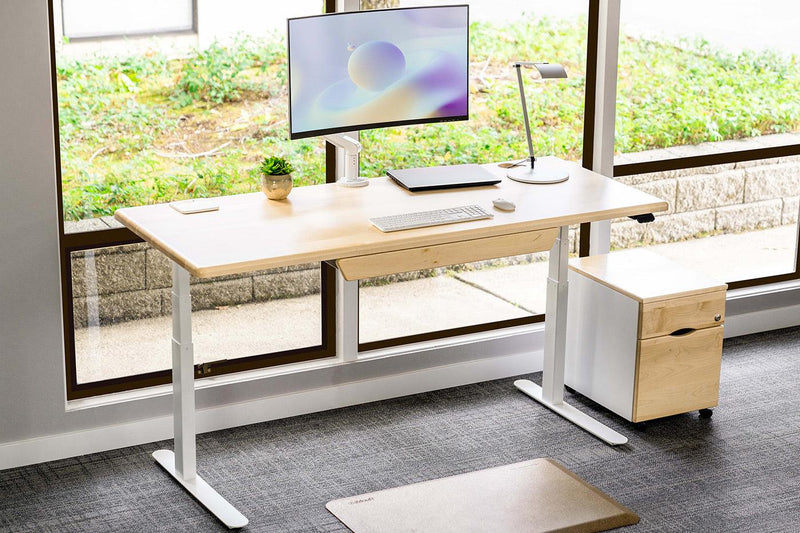
A height-adjustable desk gives your body a change of physical state without requiring you to leave the workspace or lose the creative thread.
The iMovR Lander Standing Desk is built for full-day creative use, with a whisper-quiet motor and a wide surface that handles the tools visual creatives actually need. Explore the iMovR Lander collection to build a creative studio office setup that performs across every hour of the day.
Building Movement Into the Creative Routine
Movement is a creative tool. Walking breaks are one of the most reliable ways creatives get unstuck because physical movement shifts the brain out of fixed thinking patterns.
Build sit-stand alternation into the workday. Sit for deep output. Stand for reviewing, calls, and lighter tasks. That transition becomes a cognitive signal that the mode is shifting, which helps the brain change gears faster.
Lighting, Storage, and the Details That Compound
Visual clutter creates cognitive load all day in the background. Every object in your sightline that does not belong there is an ongoing tax on attention.
Studio organization is not about tidiness. It is about keeping mental bandwidth available for actual creative work. Poor lighting works the same way. For visual designers, inaccurate color rendering is a direct quality problem.
For writers, dim or harsh light accelerates fatigue that most people misread as tiredness rather than a fixable workspace issue.
Vertical shelving keeps active materials accessible without consuming desk surface. Under-desk storage handles items used weekly.
Cable trays route connections out of the sightline entirely. For lighting, a task light paired with adjustable ambient lighting gives independent control over intensity and direction.
Cooler light at 5000 to 6500 Kelvin suits editing. Warmer tones at 2700 to 3500 Kelvin reduce eye strain during ideation sessions. A strong creator productivity setup addresses both storage and lighting from the start, not as afterthoughts.

Common Workspace Mistakes Creative Professionals Make
Most creative professionals make at least one of these. Some make all of them and then blame the work.
-
Prioritizing style over ergonomics: a desk that causes shoulder pain by 2pm is a liability, not a workspace
-
Ignoring lighting and acoustics until they become serious, expensive problems
-
Overcrowding the desk with equipment used twice a month
-
Locking a creative studio office setup into a fixed height that suits one task but fights every other
Height-adjustable workstations solve that last point directly. The flexibility to match physical state to cognitive demand is exactly what separates a high-performance creator productivity setup from a desk that just holds a monitor.
Better Environments Create Better Creative Work
Physical comfort, visual clarity, movement, and studio organization all feed directly into the quality and consistency of what you produce.
And the best workspace design for creative professionals is not the most expensive or the most photogenic.
Large standing desk for creatives is the one that reduces friction, supports your body, and keeps your brain in the right state for the work you are doing that day. That is the whole point.
So if you are ready to turn creator workspace ideas into a real, performing ergonomic creative office, explore iMovR's full range of height-adjustable workstations.
Built for professionals who treat their workspace design for creative professionals as seriously as the work itself.